DCW DAILY BRIEF-Global Digital Assets, ScienceTech & Web3 Market Intelligence

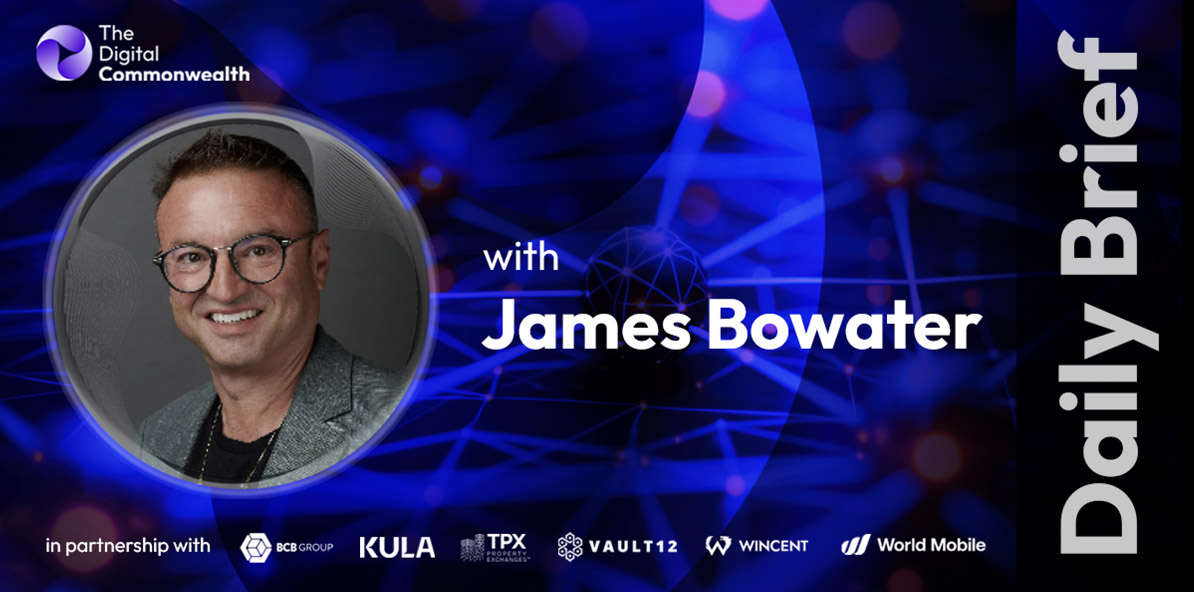
DCW DAILY BRIEF
Global Digital Assets, ScienceTech & Web3 Market Intelligence
Date: March 26th, 2026 │ Thursday Edition #422
In partnership with BCB Group | Kula | TPX property Exchanges | Vault12 | Wincent | World Mobile
James Bowater
linkedin.com/in/james-bowater-b47612 | Twitter/X: X.com@TheDCW_JB
https://www.thedigitalcommonwealth.com/

Next Event: https://www.thedigitalcommonwealth.com/
📊 EXECUTIVE SUMMARY
Markets open on Thursday, March 26th, 2026, Iran War Day 27, with a complex diplomatic picture: Iran has formally rejected the US 15-point ceasefire plan and issued its own five-point counterproposal, including a demand for sovereignty over the Strait of Hormuz, a condition the White House regards as a nonstarter. At the same time, President Trump stated early Thursday that Iran is "eager to make a deal," and the White House confirmed productive talks are continuing. Iran's Foreign Minister clarified that Tehran is reviewing the US proposal, but that no direct negotiations are underway. The Friday, 28th March strike moratorium deadline remains the defining binary risk event.
Asian markets have reversed Wednesday's ceasefire-driven gains: Japan's Nikkei fell approximately 0.7%; South Korea's KOSPI retreated 2.7%; the Hang Seng fell 1.7%. The reversal reflects the hardening reality that Iran's five-point counterproposal, particularly its demand for Hormuz control and war reparations, represents a position far from what Washington will accept. US and European futures are pointing to a weaker Thursday open. Goldman Sachs' US recession probability remains at 35% and rising.
Oil has rebounded sharply above \$100/bbl. Brent crude rose approximately +2% to above \$104/bbl as ceasefire optimism faded and Hormuz disruption fears resurfaced. Iran's drone strike ignited a fire at Kuwait International Airport's fuel tank, reinforcing supply vulnerability concerns. Brent monthly gains now exceed 40%, the largest single-month rise since the first Gulf War. Goldman Sachs' Q2 Brent target of \$110/bbl and 2008 \$147/bbl tail-risk scenario both remain in active play. The Strait of Hormuz remains commercially inaccessible.
Gold is volatile, trading in the \$4,490–\$4,530/oz range on Thursday as ceasefire uncertainty creates cross-currents: the removal of the war premium fights with the resumption of inflationary oil pressure. Silver has slipped back below the \$70 psychological mark after touching \$74 on Wednesday. Japan's two-year yield hit a 30-year high amid rate-hike bets; the dollar remains firm near recent highs. Markets are repricing Fed cuts out of 2026 entirely as energy-driven inflation reasserts.
Bitcoin is holding near \$71,000 (+0.7%), continuing its remarkable resilience through War Day 27. ETH is at ∼\$2,120 (−0.60%); XRP ∼\$1.43; SOL ∼\$91.50; ADA ∼\$0.267; DOGE ∼\$0.094. Total crypto market cap stands at ∼\$2.48T; BTC dominance ∼57.0%. The Crypto Fear & Greed Index reads ∼31 (Fear). The SEC decision on the XRP spot ETF is now 1 day away. The FTX \$2.2B creditor distribution on March 31 (5 days) is the primary near-term crypto liquidity catalyst.
The dominant Thursday narrative centres on five themes: (1) Iran's Five-Point Counterproposal: Tehran rejects the US plan and demands Hormuz sovereignty, reparations, and a halt to strikes on its officials; Trump insists Iran is eager to deal; Friday remains the binary binary deadline; (2) Oil Back Above \$100: Brent rebounds to \$104/bbl as ceasefire optimism collapses; monthly gains now exceed 40%; Kuwait airport fuel tank fire; (3) UK Bans Crypto Political Donations: Temporary ban introduced as part of electoral reform package pending a regulatory framework; (4) SEC Tokenisation Exemption Imminent: Paul Atkins signals innovation-focused tokenisation exemption within weeks; Coinbase rejects CLARITY Act again over stablecoin yield; PREDICT Act introduced to ban officials from prediction market trading; (5) Meta's VR Exit and AI Agent Pivot: Horizon Worlds shut down as Meta writes off \$80B in Reality Labs losses and acqui-hires AI agent startup Dreamer.
Iran War Day 27: Tehran Rejects US Plan, Issues Five-Point Counterproposal:
Iran formally rejected the US 15-point ceasefire plan via state media and Press TV; Tehran issued its own five-point counterproposal demanding a halt to strikes on officials, reparations, an end to hostilities, no future war guarantee, and critically sovereignty over the Strait of Hormuz; Trump stated Thursday Iran is "eager to make a deal"; Iran's Foreign Minister says the proposal is under review but denies direct negotiations; Kuwait International Airport fuel tank struck by Iranian drone, fire reported; China's defence ministry calls for immediate ceasefire; White House confirms Trump to meet Xi in China in May; Friday 28th March moratorium expiry remains the hard binary deadline.
Oil Rebounds Above \$100/bbl Brent ∼\$104 (+2%) as Ceasefire Optimism Fades:
Brent crude rebounded to above \$104/bbl (+2%) as Iran's rejection of the 15-point plan and continued Hormuz disruption erased Wednesday's ceasefire-driven retreat; WTI recovering toward \$93/bbl; monthly Brent gains now exceed 40% the largest since 1990; Kuwait airport fuel tank drone strike adds further supply anxiety; Goldman Sachs Q2 2026 Brent target of \$110/bbl unchanged; 2008 \$147/bbl record scenario remains active; Russian export capacity ~40% offline; Iraqi production constrained; Japan's two-year yield at 30-year high on rate hike bets; inflation repricing accelerating globally.
Markets Thursday Asian Indices Retreat; Futures Weaker; Dollar Firms:
Japan Nikkei −0.7%; South Korea KOSPI −2.7%; Hang Seng −1.7%; US and European futures pointing lower; Wednesday US session closed higher Dow +305 (+0.66%) to 46,429; S&P 500 +0.54% to 6,591; Nasdaq +0.77% to 21,929 on brief ceasefire optimism; Thursday reversal driven by Iran's counterproposal and oil rebound; Goldman US recession probability 35%; Japan two-year yield at 30-year high; dollar firm near recent highs despite slight pullback; Fed rate cuts priced out of 2026 entirely.
UK Bans Crypto Political Donations; Coinbase Rejects CLARITY Act Again; PREDICT Act Introduced:
UK government announces temporary ban on cryptocurrency donations to political parties as part of March 25 electoral reform package, pending a regulatory framework; Coinbase declines to support revised CLARITY Act for second time over stablecoin yield restriction provisions; bipartisan PREDICT Act introduced in US House to ban President, Congress members, and federal officials from trading on prediction markets including Polymarket and Kalshi; SEC's Paul Atkins signals tokenisation innovation exemption within weeks; Murex-Quant integration embeds tokenised deposits into MX.3 capital markets platforms.
Bitcoin ∼\$71,000 (+0.70%; War Day 27 Resilience Sustained; XRP ETF Decision 1 Day Away):
BTC at ∼\$71,000 (+0.7%) holding above \$70,000 structural support through War Day 27; ETH ∼\$2,120 (−0.60%); XRP ∼\$1.43; SOL ∼\$91.50; ADA ∼\$0.267; DOGE ∼\$0.094; total market cap ∼\$2.48T; BTC dominance ∼57.0%; Fear & Greed ∼31 (Fear); XRP spot ETF SEC decision March 27 (1 day); FTX \$2.2B distribution March 31 (5 days); Gareth Soloway: BTC path to \$80K–\$85K open if \$68K holds; XRP "genuine shot" at \$1.70; SOL most technically bullish of the four majors.
📰 TODAY'S HEADLINES
💹 MARKETS
- Oil rebounds above \$100/bbl Brent ∼\$104 (+2%) as ceasefire optimism collapses and Hormuz disruption fears return: Brent crude reversed Wednesday's 7% ceasefire-driven decline, rebounding to above \$104/bbl (+2%) on Thursday after Iran rejected the US 15-point ceasefire plan, issued a five-point counterproposal including Hormuz sovereignty demands, and a drone strike ignited a fire at Kuwait International Airport's fuel storage; WTI recovering toward ∼\$93/bbl; Brent's monthly gain now exceeds 40%, the largest single-month rise since the 1990 Gulf War; Goldman Sachs Q2 2026 Brent target of \$110/bbl unchanged; 2008 \$147/bbl record tail-risk scenario remains active under extended Hormuz closure; Russian export capacity reportedly ∼40% offline; Iraqi production constrained; Strait of Hormuz commercially inaccessible.
- Asian markets fall Thursday as Iran counterproposal ends ceasefire rally Nikkei −0.7%, South Korea −2.7%, Hang Seng −1.7%: Thursday's Asian session reversed Wednesday's ceasefire-driven gains across the board; Japan's Nikkei fell approximately −0.7%, South Korea's KOSPI −2.7%, and Hong Kong's Hang Seng −1.7%; US and European futures pointing to weaker Thursday opens; the reversal is driven by Iran's five-point counterproposal (including Hormuz sovereignty and war reparations demands) and the oil rebound above \$100; Goldman Sachs US recession probability revised up to 35%; VIX expected to climb on Thursday open; Wednesday US session closed higher Dow +305 (+0.66%) to 46,429; S&P 500 +0.54% to 6,591; Nasdaq +0.77% to 21,929.
- Gold volatile in \$4,490–\$4,530/oz range on Thursday amid competing forces: Gold is caught between two opposing dynamics: the removal of the war premium as ceasefire talks progress (even if stalled) competes with the resumption of inflationary oil pressure from Brent's rebound above \$104; spot gold is fluctuating between \$4,490 and \$4,530 on Thursday, a technically challenged position below its 21-day and 50-day SMAs; Goldman Sachs maintains year-end gold target of \$5,400; J.P. Morgan projects \$6,000 under continued dollar diversification scenarios; US Treasury 10-year yield at ∼4.40%; silver has slipped back below \$70 after touching \$74 on Wednesday.
- Inflation and rates repricing accelerates Japan's two-year yield at 30-year high; Fed cuts priced out of 2026: Higher energy prices have reignited acute global inflation concerns; markets are now pricing out all Fed rate cuts in 2026 as oil's sustained \$100+ level feeds through to CPI expectations; Japan's two-year government bond yield hit a 30-year high on rate hike bets; ECB officials signalling potential tightening bias for April/June; BoE cuts already deferred to 2027; the dollar remains firm near recent highs reflecting safe-haven demand and tightening rate differential dynamics; the US Postal Service has applied for an 8% temporary fuel surcharge on packages, illustrating the real-economy pass-through.
- Supply shock risks intensify Russia, Iraq, and Hormuz creating multi-front energy disruption: Alongside Middle East Hormuz disruption, approximately 40% of Russia's export capacity is reportedly offline and Iraqi production remains constrained, reinforcing expectations of structurally elevated energy prices; the IEA described the current situation as the "greatest global energy security challenge in history"; Goldman Sachs warns every \$10 rise in oil adds 0.3% to US inflation; US farmers face serious fertiliser supply constraints as ∼one-third of global seaborne fertiliser trade transits the Strait of Hormuz; QatarEnergy said Iranian missile strikes have reduced LNG export capacity by 17%, with up to five years needed for repairs.
⚖️ REGULATORY & POLICY
- UK bans cryptocurrency donations to political parties temporary restriction pending regulatory framework: The United Kingdom has announced a ban on cryptocurrency donations to political parties, candidates, and other regulated entities, introduced as part of a broader package of electoral reforms unveiled on March 25, 2026; the measure reflects growing concern over transparency, donor verification, and potential foreign interference enabled by the pseudonymous nature of blockchain transactions; the ban covers cryptocurrencies, stablecoins, and other tokenised assets; officials stated the restriction is temporary, pending the establishment of a comprehensive digital asset political financing framework; UK regulators are actively developing the governance structure required to permit regulated digital asset political donations in future.
- Coinbase rejects CLARITY Act for second time stablecoin yield prohibition deepens regulatory impasse: Coinbase has again declined to support the revised Digital Asset Market Clarity Act, citing provisions that would prohibit crypto platforms from offering yield on stablecoin balances directly or via economically equivalent mechanisms; the second rejection reinforces the growing divide between crypto-native firms and bipartisan lawmakers seeking to define the regulatory perimeter for digital assets; Coinbase communicated its position to lawmakers this week; the revised CLARITY Act, backed by a bipartisan Senate group, argues that stablecoin yield mechanisms blur the boundary between payment instruments and investment products; stablecoin market cap now exceeds \$150 billion with daily transaction volumes regularly surpassing \$50 billion; Senate Banking Committee markup targeted for the second half of April.
- Bipartisan PREDICT Act introduced bill would ban President, Congress members, and federal officials from prediction market trading: A bipartisan coalition in the US House of Representatives introduced the Preventing Real-time Exploitation and Deceptive Insider Congressional Trading Act (PREDICT Act), sponsored by Representative Adrian Smith (R-NE) and Representative Nikki Budzinski (D-IL); the bill targets the regulatory loophole that currently permits public officials to wager legally on policy decisions and geopolitical outcomes using platforms including Polymarket and Kalshi; the legislation arrives amid mounting scrutiny over government insiders utilising decentralised and regulated forecasting platforms; the bill represents the most targeted legislative effort yet to close the prediction market conflict-of-interest gap.
- SEC signals imminent tokenisation innovation exemption Paul Atkins points to conditional framework within weeks: SEC Commissioner Paul Atkins has indicated that an innovation-focused tokenisation exemption could be introduced within weeks, allowing firms to develop tokenised financial products under a conditional exemption structure without full securities registration; the proposed framework is time-bound and conditional, comparable to regulatory sandboxes used in jurisdictions including the UK and Singapore; Atkins stated at a recent policy forum that regulators are actively evaluating frameworks for tokenised securities and real-world asset issuance; the exemption would represent the most concrete step toward accommodating blockchain-based financial infrastructure within US regulatory boundaries; the announcement follows Wednesday's landmark House tokenisation hearing and builds on the Nasdaq pilot (SEC-approved March 18) and NYSE-Securitise partnership.
- XRP spot ETF SEC decision March 27 final catalyst 1 day away: The SEC's decision on pending spot XRP ETF applications is now due tomorrow, March 27, and remains the most asymmetric regulatory binary in the current crypto cycle; the SEC/CFTC's March 17 classification of XRP as a digital commodity makes rejection internally contradictory in the view of multiple legal analysts; eight pending applications remain under review; approval is expected to catalyse a 30–50%+ same-session price move toward the 0.618 Fibonacci level at \$1.92; analyst Gareth Soloway describes XRP's chart setup as "very good" with a genuine shot at \$1.70; broader altcoin risk-on proxy impact expected for SOL, ADA, and the wider digital commodity ecosystem.
🤖 TECHNOLOGY & INNOVATION
- Meta shuts down Horizon Worlds VR \$80B Reality Labs losses written off; full pivot to AI agents: Meta has shut down the VR version of Horizon Worlds, capping approximately \$80 billion in cumulative Reality Labs losses since 2020; the VR edition will be removed from the Quest store by March 31 and fully discontinued from VR on June 15; only a mobile version survives; in parallel, Meta acqui-hired AI agent startup Dreamer this week, its third agent-focused acquisition in four months following Manus and Moltbook; Meta is planning \$135 billion in capital expenditure in 2026, nearly double 2025 spending, with the vast majority directed at AI infrastructure; Meta employees are reportedly adopting MyClaw, a personal AI agent built on OpenClaw, with some granting agents access to chat logs and work files to operate continuously.
- smartTrade launches Agentic Copilot governed AI for institutional trading and payments workflows: smartTrade has announced the Agentic Copilot, a system designed to integrate AI into trading and payments workflows while maintaining the control, security, and compliance requirements expected by financial institutions; the product builds on existing AI tools by extending capabilities across multiple modules, enabling natural language interaction with trading systems while retaining human oversight of decision-making processes; the launch reflects increasing institutional demand for AI systems that can operate within regulatory constraints around data privacy, latency, and compliance; the development coincides with Solana Foundation's positioning of Solana as core infrastructure for the emerging "agentic internet".
- Google sets 2029 deadline for quantum-resistant cryptography transition: Google has established a 2029 target for transitioning its systems to post-quantum cryptography, marking a significant milestone in the industry-wide effort to safeguard digital infrastructure against long-term quantum computing risks; the timeline aligns with growing consensus that current encryption standards (RSA and elliptic curve cryptography) present a credible long-term vulnerability for financial transactions, cloud infrastructure, and blockchain networks; the transition requires replacing existing encryption algorithms with quantum-resistant alternatives, many of which are still being standardised; Google's decision underscores the scale and complexity of the migration required across software, hardware, and network infrastructure; the 2029 deadline implies significant enterprise and financial services preparation should begin immediately.
- Murex and Quant integrate tokenised deposits and digital bonds into MX.3 capital markets platform: Murex has announced a partnership with Quant to integrate tokenised deposits and digital bonds into its MX.3 platform, enabling banks and capital markets firms to issue, manage, and settle tokenised instruments within existing trading, risk management, and post-trade operations infrastructure; the approach embeds new digital asset capabilities into established workflows rather than creating separate infrastructure; the integration positions MX.3 as a key bridge between legacy capital markets systems and the tokenised asset ecosystem; tokenised real-world assets have now surpassed \$100 billion, with increasing participation from major financial institutions; the collaboration follows the NYSE-Securitise and Nasdaq tokenisation pilot announcements earlier this week and reinforces the momentum toward institutional tokenisation infrastructure convergence.
🏢 INSTITUTIONAL & CORPORATE
- Spot Bitcoin ETF flows institutional accumulation at \$70,000 level continues through War Day 27: BTC spot ETF institutional flows are being monitored for Thursday's data following Wednesday's session; total BTC ETF NAV stands at ∼\$90B (6.44% of total BTC market cap); Strategy's 762,099 BTC treasury continues to demonstrate institutional conviction at the \$70,000 level; analyst Gareth Soloway maintains \$80,000–\$85,000 target for BTC with \$68,000 as the critical support level; the pattern of institutional accumulation at \$70,000–\$72,000 versus gold's sustained decline from ATH is increasingly framed as a structural regime shift in relative geopolitical hedge performance; \$14.16 billion in Bitcoin options expire Friday on Deribit with max pain at \$75,000, creating potential gravitational pull for spot price into expiry.
- FTX \$2.2B creditor distribution on March 31 5 days away primary near-term crypto liquidity catalyst: The FTX creditor distribution (total \$10B returned; Class 7 at 120% recovery) via BitGo/Kraken/Payoneer is now 5 days away and remains the single most significant near-term crypto-specific liquidity event; historical analysis of exchange credit returns suggests a meaningful portion of distributed capital returns to crypto markets; the extreme fear positioning at current Fear & Greed levels (∼33) creates an asymmetric upside scenario if the distribution coincides with a diplomatic breakthrough on or before Friday.
- Bhutan moves additional 500 BTC to exchanges 2026 outflows exceed \$150M: The Royal Government of Bhutan transferred 519.707 BTC on Wednesday, the latest in a series of increasingly large moves that have taken its holdings from a peak of approximately 13,000 BTC to 4,453; total 2026 outflows from the Bhutan sovereign treasury now exceed \$150 million; the sustained liquidation suggests sovereign fiscal pressure or deliberate strategic rebalancing; institutional analysts are closely monitoring the transfers for their potential impact on BTC spot market liquidity during the current Iran war volatility period.
- Hostplus (\$105B AUM) continues Bitcoin evaluation potential landmark for Australia's \$4.5T superannuation sector: Australia's Hostplus superannuation fund continues to evaluate Bitcoin and digital asset exposure through its Choiceplus self-directed investment option with a potential live date next financial year; if implemented, this would represent a landmark signal for the strictly regulated \$4.5 trillion Australian superannuation sector; the Hostplus evaluation sits alongside Bitmine's \$138M ETH purchase (its third consecutive weekly buy) as the leading institutional conviction signals of the current period; an X Money launch in April with Benji Taylor (former Aave Labs CPO and Coinbase Base design lead) joining X's crypto-savvy design team reinforces the broader institutional and consumer digital payments momentum.
📈 MARKET OVERVIEW
🌐 TOTAL CRYPTO MARKET CAP: ∼\$2.48 TRILLION
24h Change: BTC holding above \$70,000 through War Day 27; oil rebounds above \$100; Iran five-point counterproposal ends ceasefire rally; Asian equities retreat; Fear & Greed ∼33 (Fear). Bitcoin Dominance: ∼57.0%
₿ BITCOIN (BTC) Price: ∼$71,000 (+0.70%; Sustained Hold Above $70,000 Through War Day 27)
24h Volume: ∼\$29.0B │ Market Cap: ∼\$1.41 Trillion │ Dominance: ∼57.0% │ 24h Range: ∼\$70,200–\$71,500
Bitcoin is at ∼\$71,000, maintaining its hold above the \$70,000 structural support level for another session through the most complex geopolitical day of the conflict: Iran's formal rejection of the 15-point plan and issuance of its own five-point counterproposal has not broken BTC's institutional demand floor. The +0.7% move is constructive given the reversal in Asian equity markets and the oil rebound above \$100. BTC is now outperforming gold by approximately 4 percentage points on the day, with gold volatile in the \$4,490–\$4,530 range while BTC holds firm.
\$14.16 billion in Bitcoin options expire on Deribit on Friday, March 27, with max pain at \$75,000; this creates gravitational pull for spot price toward \$75,000 into expiry and represents a secondary near-term catalyst alongside the XRP ETF decision. Analyst Gareth Soloway maintains his \$80,000–\$85,000 BTC target, with \$68,000 as the critical technical support; BTC has held higher highs and higher lows. Key near-term catalysts: (1) XRP spot ETF SEC decision March 27 (1 day); (2) FTX \$2.2B distribution March 31 (5 days); (3) Deribit options expiry Friday at \$75,000 max pain; (4) Friday 28th March ceasefire deadline. Key support \$68,000–\$70,000; resistance \$72,000–\$75,000.
Ξ ETHEREUM (ETH) Price: ∼$2,120 (−0.60%; Lagging BTC; BlackRock ETHB Staking Decision Approaching April)
24h Volume: ∼\$14.0B │ Market Cap: ∼\$255 Billion │ 24h Range: ∼\$2,095–\$2,165
Ethereum is at ∼\$2,120, modestly underperforming Bitcoin as the ETH/BTC ratio remains suppressed amid macro risk-off conditions. The approaching April SEC decision on BlackRock's ETHB staking ETF, the first yield-generating Ethereum product on US markets, is the dominant near-term institutional catalyst. Bitmine (Tom Lee's treasury firm) extended its ETH buying streak with a \$138M purchase last week (its third consecutive weekly buy), and the Ethereum Foundation's 38-page governance mandate formalising the L1/L2 architecture and the EF's planned reduction of institutional influence remain the structural maturation signals of the current period. The Glamsterdam hard fork (May), targeting gas limit expansion and a Pectra upgrade, is a medium-term positive. Critical near-term support at \$2,100; a sustained break above \$2,440 would confirm a bullish structural shift on the daily chart.
🔷 XRP Price: ∼$1.43 │ 24h Volume: ∼$4.2B │ Market Cap: ∼$82B
XRP is at ∼\$1.43, holding its \$1.40–\$1.45 consolidation band as the SEC ETF decision approaches in 1 day. XRP volatility has compressed to cycle lows. Analyst Gareth Soloway describes the chart setup as "very good", with XRP having broken out, pulled back, held support, and now setting up for a potential next leg to \$1.70. The \$1.40 level is the critical support floor; the CoinDesk note that "XRP volatility hits cycle lows as \$1.40 support comes into focus" reinforces the binary nature of tomorrow's catalytic event. Total XRP ETF net assets stand at \$1.01 billion (1.14% of market cap). RLUSD (Ripple's stablecoin) is maintaining its market cap above \$1B through the conflict period. A positive SEC decision tomorrow would represent the most significant XRP-specific regulatory catalyst since the dismissal of the Ripple case.
◎ SOLANA (SOL) Price: ∼$91.50 (+0.90%; Most Technically Bullish of the Four Majors) │ 24h Volume: ∼$3.9B │ Market Cap: ∼$48B
Solana is at ∼\$91.50, and is described by analyst Gareth Soloway as "actually looking the most bullish" of the four major cryptos, with a clean chart structure and well-defined upside trajectory; Solway's near-term targets are \$100 (half position) and \$105 (second tranche), with a best-case return to the \$118 resistance area; Solana has technically reclaimed the 0.382 Fibonacci level at \$89.97 a meaningful structural development; the next resistance sits at the 0.500 Fib level at \$97.35, coinciding with the psychological \$100 level. The Mastercard stablecoin settlement testing on Solana and Western Union cross-border fiat-to-stablecoin deployment represent the most significant institutional adoption events for SOL in Q1 2026. SOL spot ETF recorded \$21M in inflows last week; Morgan Stanley's ETF application is under SEC review. The Alpenglow consensus upgrade (100–150ms finality; 98.27% validator approval) is the dominant medium-term technical catalyst. A positive XRP ETF decision tomorrow would function as a proxy altcoin risk-on catalyst, potentially dragging SOL above \$95.
🔺 CARDANO (ADA) Price: ∼$0.267 │ 24h Volume: ∼$560M │ Market Cap: ∼$9.6B
Cardano is at ∼\$0.267, tracking broad altcoin conditions with modest volatility. The SEC's Digital Commodity classification, which confirms that ADA staking is not a securities event, remains a structural positive. Protocol Version 11, the Midnight privacy partner chain mainnet, and Leios scaling (targeting ∼1,000 TPS) are the 2026 catalysts. Hoskinson's opposition to the CLARITY Act remains the US institutional adoption overhang. The \$0.24–\$0.25 floor is the critical support zone; a positive XRP ETF decision tomorrow would likely drag ADA above \$0.30 as a proxy altcoin risk-on catalyst.
💕 DOGECOIN (DOGE) Price: ∼$0.094 (Digital Collectable; Highest-Beta Macro Risk Indicator) │ 24h Volume: ∼$1.1B │ Market Cap: ∼$14B
Dogecoin is at ∼\$0.094, reflecting the persistent macro risk-off tone across retail-driven assets. DOGE remains more than 60% below its early-January peak. The \$0.10 psychological resistance is the primary hurdle to recovery. The X Payments launch (April) with Benji Taylor, former CPO at Aave Labs and design head at Coinbase's Base, now joining X's crypto-savvy team, and X Money integration remain medium-term catalysts. DOGE requires a macro risk-on signal, specifically a genuine ceasefire announcement, to re-engage retail speculative demand. The \$0.085–\$0.090 range is the near-term critical support band.
😨 Crypto Fear & Greed Index: ∼33 (Fear)
Thursday's Fear & Greed reading of ∼31 remains in "Fear" territory, reflecting ongoing macro headwinds and the reversal of Wednesday's ceasefire optimism: Iran's five-point counterproposal has ended the brief diplomatic relief, oil has rebounded above \$100, and Asian equity markets are retreating. The index has moved marginally higher from mid-March lows of 10–12 (Extreme Fear) as BTC's structural hold above \$70,000 provides a floor against deeper sentiment deterioration. Historical Glassnode data compiled across all instances where the index dipped below 25 shows an average 30-day return of +18% for Bitcoin. The Friday 28th March binary breakthrough or strike resumption, combined with tomorrow's XRP spot ETF decision, represents a dual catalyst that could determine whether the index begins its recovery toward 50–65 Neutral/Greed within 2–4 weeks, or retests the single-digit readings seen earlier this month. The
FTX \$2.2B distribution on March 31 (5 days)
remains the primary crypto-specific liquidity catalyst that could independently support a sentiment recovery irrespective of the geopolitical binary.
🏛️ TRADITIONAL MARKETS CONTEXT
Thursday's market session is defined by the inversion of Wednesday's ceasefire-driven optimism. Iran's formal rejection of the US 15-point plan and the issuance of a five-point counterproposal, with sovereignty over the Strait of Hormuz as a central demand, have shattered the diplomatic optionality markets had been pricing. The counterproposal's most problematic element is not the principle of negotiation but the specific demand for Hormuz control: this is constitutionally impossible for Washington to concede, as the Strait's international status as an international waterway is foundational to US strategic doctrine and the global energy security architecture. Iran's parliamentary speaker, Qalibaf, has been floated as a potential US contact, suggesting that a back-channel architecture may exist even as public positions harden.
Brent crude's rebound to above \$104/bbl (+2%) on Thursday represents a full reversal of Wednesday's 7% ceasefire-driven retreat. The oil market's behaviour over the past 72 hours perfectly encapsulates the binary structure of the current geopolitical environment: Iran rejects the plan → oil rebounds; Iran shows flexibility → oil retreats. Monthly Brent gains now exceed 40%, the largest single-month rise since the 1990–91 Gulf War. Kuwait International Airport's fuel tank being struck by an Iranian drone on Wednesday adds direct physical supply anxiety to the already severe Hormuz disruption calculus. Additional supply-side headwinds from Russia (∼40% export capacity offline) and Iraq (constrained production) mean there is no secondary supply cushion available at the required speed to offset Hormuz disruption.
Gold's Thursday range of \$4,490–\$4,530/oz reflects the paradox created by this specific conflict's interaction with the gold price mechanism. The war initially sent gold to new all-time highs above \$5,595 in January. Still, the subsequent oil price surge above \$110 reignited global stagflation fears, forcing central banks into a hawkish posture that undermined gold's non-yielding appeal. Now, as ceasefire optimism and pessimism alternate, gold oscillates: war premium additions fight dollar strength from rate divergence. Japan's two-year yield at a 30-year high is the most acute expression of this dynamic outside the US and the signal that global rate repricing driven by energy inflation is far from complete. Silver's retreat below \$70 after touching \$74 on Wednesday illustrates the same volatility regime.
The macroeconomic damage from 27 days of sustained oil at \$95–\$110/bbl is now visible in hard data: Japan's 30-year yield high, the US Postal Service's 8% fuel surcharge application, Thailand abandoning its domestic fuel price cap, US farmer fertiliser supply constraints, and Slovenia's ongoing emergency fuel rationing represent a cross-section of the real-economy transmission already embedded in the global system regardless of Friday's outcome. Every additional day of conflict above \$100/bbl adds incrementally to the inflation overhang that will constrain central bank flexibility in H2 2026 and beyond.
💡 DCW INTELLIGENCE & INSIGHTS
Iran War Day 27: The Five-Point Counterproposal, the Hormuz Sovereignty Demand, and the Friday Binary.
The dominant intelligence themes for March 26th converge on three structural developments with immediate and long-term significance.
First, Iran's five-point counterproposal is not a negotiating position; it is a strategic statement. The demand for sovereignty over the Strait of Hormuz is structurally impossible for the United States to accept: the Strait's status as an international strait under the UN Convention on the Law of the Sea (UNCLOS) is the legal and strategic foundation of global energy security. If Iran genuinely sought to de-escalate, the counterproposal would have addressed the nuclear programme, ballistic missile limitations, and proxy force withdrawal, the three elements of the US's original war justification. Instead, the counterproposal escalates the territorial demand to its maximum point. This suggests one of two interpretations: either Iran is using the counterproposal as a domestic political signal to its military and hardline constituencies, signalling defiance while leaving back-channel space open; or Iran is genuinely testing the outer boundary of what the Trump administration will accept before the Friday deadline. Trump's statement that Iran is "eager to make a deal" is inconsistent with the counterproposal's content but may reflect intelligence on back-channel sentiment that differs from the public posture. DCW members should monitor whether Witkoff or Kushner's back-channel engagement with Iran via Oman or Pakistan produces any signal of flexibility on the nuclear/missile dimensions, specifically, rather than the Hormuz demand, which serves as a structural anchor for Iran's public position.
Second, the Meta Horizon Worlds shutdown and AI agent pivot is the most consequential single corporate strategic reversal in the metaverse-to-AI transition. Zuckerberg renamed an entire company for a vision he is abandoning less than five years later. The metaverse was not a wrong concept; it was wrong on timing, wrong on hardware requirements (mass VR adoption requires lightweight, affordable hardware that does not yet exist at scale), and wrong on the anthropological assumption that people will voluntarily strap a headset to their face for social interaction. The \$80B in Reality Labs losses is a brutal learning cost. The pivot to AI agents Dreamer, Manus, Moltbook in four months; \$135B CapEx in 2026; MyClaw internal adoption with work file and calendar access represents the correct strategic direction. The relevance for DCW members advising on AI governance and the human-AI interface risk framework: Meta's MyClaw deployment at scale (employees granting agents 24/7 access to chat logs and work files) is the clearest single corporate data point yet of the AI governance challenge transitioning from theoretical concern to operational reality.
Third, the SEC tokenisation exemption signal from Paul Atkins, alongside Coinbase's second rejection of the CLARITY Act, defines the bifurcation point in US digital asset regulatory architecture. The exemption Atkins is proposing would, if implemented, create a regulatory sandbox framework for tokenised securities issuance that sits parallel to, rather than inside, the existing securities registration regime. This is architecturally distinct from the CLARITY Act's market structure approach. For DCW members advising on RWA strategy, the immediate analytical question is whether the Atkins exemption accelerates or decelerates CLARITY Act momentum: our view is that a well-designed exemption, rather than creating confusion, would serve as a proof-of-concept for the legislative framework establishing real-world tokenisation case data that the Senate Banking Committee can review during the April markup. The PREDICT Act's introduction simultaneously signals that Congress is becoming acutely aware of the ways digital assets and prediction markets intersect with political conflict-of-interest dynamics that require legislative attention.
🔴 ELEVATED RISKS: Geopolitical, Macro & Market Structure
- Iran Five-Point Counterproposal: Hormuz sovereignty demand structurally impossible for US to accept; reparations and no-future-war guarantee also likely nonstarters; Iran's Foreign Minister says US plan under review but denies direct talks; Friday 28th March binary remains breakthrough or resumption of infrastructure strikes; Kuwait airport fuel tank drone strike adds supply anxiety; Goldman \$147/bbl 2008 record in tail-risk framework
- Oil Back Above \$100/bbl: Brent ∼\$104 (+2%) Thursday; monthly gains >40%; Goldman Q2 target \$110/bbl unchanged; Russia ∼40% export capacity offline; Iraq constrained; Hormuz commercially inaccessible; Iran LNG strike reduces Qatar export capacity 17%; fertiliser supply chain disruption accelerating; \$10/bbl rise adds 0.3% to US inflation (Goldman)
- Asian Markets Retreat Thursday: Nikkei −0.7%; South Korea −2.7%; Hang Seng −1.7%; US and European futures weaker; Goldman US recession probability 35%; Japan two-year yield at 30-year high; Fed rate cuts now priced out of 2026 entirely; US Postal Service applying 8% fuel surcharge
- Gold Volatile; Silver Below \$70: Gold \$4,490–\$4,530 trapped between competing forces; silver retreats below \$70 after touching \$74 Wednesday; gold 18–20% below January \$5,595 ATH; hawkish central bank rates undermining non-yield appeal
- Macro Deceleration Deepening: Goldman recession probability 35%; S&P 500 ∼5% YTD below 200-day MA; Nasdaq average member −30% from peak; Japan rate hike fears; EU energy rationing spreading; UK CPI data under pressure; PMI deterioration across G4 from 27 days of energy shock
🟢 POSITIVE DEVELOPMENTS: Regulatory, Diplomatic & Structural
- Trump-Xi Summit May: White House confirms Trump to meet President Xi in China in May; China's defence ministry calls for immediate ceasefire; potential multilateral diplomatic architecture forming behind the public US-Iran binary
- XRP ETF Decision 1 Day Away: March 27 SEC decision is the most asymmetric binary in the current crypto calendar; SEC/CFTC commodity classification makes rejection internally contradictory; eight pending applications; approval expected to catalyse 30–50%+ same-session XRP move; Soloway: XRP has "genuine shot at \$1.70"; broader altcoin proxy risk-on for SOL, ADA
- SEC Tokenisation Exemption Imminent: Paul Atkins signals innovation exemption within weeks for tokenised securities; builds on House hearing, NYSE-Securitise, Nasdaq pilot, Murex-Quant integration; Atkins framework time-bound and conditional; potential proof-of-concept for CLARITY Act Senate markup April
- BTC Structural Support Intact: \$71,000 through War Day 27; Deribit max pain \$75,000 Friday creating gravitational pull; Soloway \$80K–\$85K target active; institutional demand floor (Strategy 762,099 BTC; ETF NAV \$90B) resilient; Fear & Greed recovering from single-digit lows to ∼33
- FTX \$2.2B Distribution 5 Days (March 31): Primary near-term crypto liquidity event; Class 7 at 120% recovery; historical capital return patterns suggest meaningful crypto market re-entry; asymmetric upside if it coincides with Friday's diplomatic breakthrough
- Regulatory Framework Crystallising: PREDICT Act, UK crypto donation ban, CLARITY Act Senate markup April, GENIUS Act July 18, the most comprehensive US and UK digital asset regulatory architecture is being assembled simultaneously; Google's 2029 quantum-resistant deadline aligns industry on post-quantum transition timeline
💸 STABLECOINS, TOKENISATION & REGULATORY FRAMEWORKS
Thursday's regulatory landscape is defined by the deepening CLARITY Act impasse and the emerging Atkins exemption pathway as two competing approaches to the same underlying problem: how to integrate tokenised assets and stablecoin infrastructure into the US financial system without either suppressing innovation or creating systemic risk. Coinbase's second rejection of the CLARITY Act is not simply a lobbying dispute over yield revenue; it is a structural disagreement about whether stablecoins are payment instruments (the CLARITY Act model) or financial products that can generate yield (the market model). The \$150 billion stablecoin market cap and \$50+ billion in daily transaction volumes mean this is no longer a marginal regulatory question; it is the central architecture decision for the future of dollar-denominated digital finance.
The UK's temporary ban on political donations in cryptocurrency is a smaller but symbolically significant development for DCW members engaged in UK regulatory strategy. The ban's framing as a temporary precautionary measure pending a regulatory framework suggests the UK government intends to permit digital asset political donations in future under a supervised regime, rather than prohibit them permanently. This is consistent with the FCA's incremental approach to crypto regulation and aligns with the broader HM Treasury digital asset framework development. The transparency and donor-verification concerns cited mirror exactly the challenges regulators face with stablecoin compliance across AML/KYC frameworks. The political donation context makes them politically visible in a way that stablecoin velocity typically does not.
The Paul Atkins tokenisation exemption signal, combined with the Murex-Quant MX.3 tokenised deposits integration, represents the two simultaneous pathways by which tokenisation is becoming operational: top-down via SEC regulatory accommodation, and bottom-up via institutional infrastructure integration into existing capital markets plumbing. DCW members advising on RWA strategy should note that the Murex-Quant integration is architecturally significant because MX.3 is genuinely tier-one capital markets infrastructure rather than a proof-of-concept sandbox. Banks that are already MX.3 users can now access tokenised instrument capabilities within their existing operational workflow without a separate infrastructure investment. This is the integration model that will drive institutional tokenisation adoption in practice, not the bespoke blockchain pilots of 2021–2024.
🌍 GLOBAL MONETARY POLICY & MACROECONOMIC
The G4 central bank picture has hardened materially on Thursday as oil's rebound above \$100/bbl reverses the modest dovish repricing introduced by Wednesday's ceasefire optimism. The central bank consensus as of Thursday is the most restrictive since the conflict began: Fed rate cuts priced out of 2026 entirely; Bank of Japan rate-hike expectations are acute, with the two-year JGB yield at a 30-year high; ECB tightening bias for April/June; BoE deferred to 2027. This simultaneous hawkish pivot across G4 central banks, driven by a single supply shock, is the defining macro feature of the current environment. It is structurally different from post-COVID tightening because it combines supply disruption (energy shortage) with demand erosion (recession risk) in the classic stagflationary pattern.
Japan remains the most exposed G7 economy: 95% crude import dependence on Middle East oil, two-year yields at 30-year highs, and the Nikkei's sharp −0.7% Thursday reversal from Wednesday's +3% ceasefire surge demonstrate the extreme binary sensitivity of Japanese financial markets to Hormuz access. Prime Minister Takaichi's discussions on a joint US-Japan strategic petroleum reserve venture remain active, but cannot substitute for physical access to the Hormuz. South Korea's −2.7% KOSPI retreat on Thursday reflects the Korean economy's similar dependence on fossil fuel imports, alongside an already-stressed Won near two-decade lows against the dollar. China's continued insulation via strategic reserves and access to Iranian oil creates a structural divergence in the impact of the Iran war across the Indo-Pacific, which is increasingly visible in relative equity market performance.
The dollar's firmness near recent highs, despite a slight Thursday pullback, reflects the complex safe-haven dynamics created by this specific conflict: the dollar benefits from widening rate differentials (Fed hawkishness versus other G4), from safe-haven demand, and from oil-dollar recycling via Gulf sovereign wealth funds. However, it faces headwinds from the longer-term dollar diversification trend that J.P. Morgan identifies as the pathway to \$6,000 gold and which represents the secular structural force that Bitcoin's institutional narrative as "digital gold" is designed to capture. The Trump-Xi summit in May introduces a geopolitical wildcard: if China uses the meeting to signal support for a negotiated Hormuz settlement, the impact on oil, the dollar, and global rate expectations would be significant and rapid.
📰 Other News Stories
- Asian markets Thursday: Nikkei −0.7%; South Korea KOSPI −2.7%; Hang Seng −1.7% on Iran five-point counterproposal and oil rebound; US and European futures weaker; Wednesday US session closed higher Dow +305 (+0.66%) to 46,429; S&P 500 +0.54% to 6,591; Nasdaq +0.77% to 21,929; Goldman US recession probability 35%; Japan two-year yield at 30-year high
- Gold \$4,490–\$4,530/oz (volatile, competing forces); silver slips below \$70 after touching \$74 Wednesday; gold 18–20% below January \$5,595 ATH; Goldman year-end target \$5,400; J.P. Morgan projects \$6,000 under continued dollar diversification; 10yr Treasury ∼4.40%; dollar firm near recent highs
- Brent ∼\$104/bbl (+2%); WTI recovering toward ∼\$93/bbl; monthly gains >40%; Goldman Q2 target \$110/bbl unchanged; 2008 \$147/bbl tail-risk scenario active; US gas prices continuing multi-week rise; Kuwait airport fuel tank fire; Russia ∼40% export capacity offline; Hormuz commercially closed
- BTC ∼\$71,000 (+0.70%; holding \$70,000 structural support through War Day 27); ETH ∼\$2,120 (−0.60%); XRP ∼\$1.43; SOL ∼\$91.50; ADA ∼\$0.267; DOGE ∼\$0.094; total market cap ∼\$2.48T; BTC dominance ∼57.0%; Fear & Greed ∼33 (Fear); XRP ETF decision March 27 (1 day); FTX \$2.2B distribution March 31 (5 days)
- Meta shuts Horizon Worlds VR (Quest store March 31; full VR shutdown June 15) ∼\$80B Reality Labs losses; \$135B AI CapEx 2026; Dreamer acqui-hire (third agent deal in four months); MyClaw internal agent adoption with work file access
- UK bans crypto donations to political parties, a temporary measure as part of the March 25 electoral reform package; ban covers cryptocurrencies, stablecoins, and tokenised assets; pending a regulatory framework to permit supervised digital asset political financing in future
- Coinbase rejects CLARITY Act second time stablecoin yield prohibition "reduces consumer utility and undermines innovation"; stablecoin market cap >\$150B; daily volumes >\$50B; Senate Banking Committee markup targeted second half of April
- PREDICT Act introduced bipartisan bans President, Congress, and senior federal officials from prediction market trading (Polymarket, Kalshi); Adrian Smith (R-NE) and Nikki Budzinski (D-IL) sponsors; closes conflict-of-interest loophole in decentralised and regulated forecasting platforms
- SEC tokenisation exemption imminent, Paul Atkins signals innovation-focused conditional exemption within weeks; time-bound sandbox model; builds on NYSE-Securitise, Nasdaq pilot, House hearing; CLARITY Act Senate markup April
- Google 2029 quantum-resistant cryptography deadline transition from RSA/elliptic curve to post-quantum algorithms across software, hardware, and network infrastructure; aligns with NIST post-quantum standardisation timeline; material implications for blockchain cryptographic security
- Murex-Quant tokenised deposits integration MX.3 platform now supports tokenised instruments within existing capital markets workflows; tokenised RWA market now >\$100B; tier-one infrastructure integration marks maturation of tokenisation beyond proof-of-concept pilots
- Silver slips below \$70 retreated from Wednesday's \$74 high; mixed ceasefire messaging driving acute volatility; \$65 intraday low Monday to \$74 high Wednesday to below \$70 Thursday; geopolitical headline sensitivity extreme
- smartTrade Agentic Copilot AI-native trading and payments system with natural language interface and institutional-grade compliance controls; reflects accelerating demand for governed AI in financial services; aligned with Solana Foundation's agentic internet thesis
- Bhutan transfers 519 BTC to exchanges. 2026 outflows exceed \$150M; holdings reduced from ∼13,000 BTC peak to 4,453; sovereign fiscal pressure or strategic rebalancing; monitored for spot market liquidity impact
- White House confirms Trump-Xi summit in China (May), potential multilateral diplomatic architecture for Hormuz resolution; China calls for immediate ceasefire; key wildcard for Q2 macro path
📅 Looking Ahead March 2026
Key Events and Catalysts:
This Week:
The defining event of the week remains Trump's five-day pause, which expires on Friday, 28th March, now 1 day away. The binary outcome, a genuine diplomatic breakthrough via Iran's engagement with the US 15-point plan (notwithstanding Tehran's current counterproposal posture), or resumption of infrastructure strikes, will set the risk asset direction for the subsequent month. Thursday's key watch points are: (a) whether any back-channel signal emerges from Oman, Pakistan, or the China track indicating Iranian flexibility on the nuclear/missile dimensions separate from the public Hormuz demand; (b) whether Trump's statement that Iran is "eager to deal" reflects intelligence not visible in state media; (c) whether the Friday Deribit options expiry at \$75,000 max pain creates gravitational BTC pull into settlement. The XRP spot ETF SEC decision on March 27 (tomorrow) is the week's primary crypto-specific binary. An approval would catalyse a 30–50%+ same-session XRP move and function as a broad altcoin risk-on proxy, with Solana, ADA, and DOGE as the primary beneficiaries.
March 2026:
The FTX \$2.2B creditor distribution on March 31 (5 days) is the primary near-term crypto liquidity event. BlackRock ETHB staking ETF SEC decision approaching April. X Money launches in April with a new crypto-savvy design lead, Benji Taylor. GENIUS Act advancing toward July 18. Bitcoin reserve bills are advancing in Arizona, Missouri, Texas, and Indiana. CLARITY Act Senate Banking Committee markup targeted for the second half of April. Morgan Stanley SOL ETF application under SEC review. Ethereum's Glamsterdam hard fork (May). SEC tokenisation innovation exemption potentially within weeks (Atkins signal). Google's 2029 quantum-resistant cryptography transition programme is beginning enterprise planning. CONV£RGENCE London at Mansion House (April 22nd) convenes at the height of the Iran war's macro impact on the digital asset and Web3 ecosystem.
Q1–Q2 2026 Broader Themes:
The Friday 28th March binary Iran five-point counterproposal engagement or strike resumption as the conflict's most acute current decision node; Bitcoin's sustained hold above \$70,000 through 27 days of Iran War pressure as the definitive validation of the institutional ETF-driven demand floor thesis; the tokenisation infrastructure convergence (NYSE-Securitise, SEC exemption signal, Nasdaq pilot, Murex-Quant MX.3 integration) as the decade-defining architecture for the transition of \$100T of traditional assets onto blockchain rails; the CLARITY Act stablecoin yield ban as the most consequential single legislative provision for the DeFi competitive landscape in 2026; the XRP commodity classification and ETF decision as the prototype for how the March 17 SEC/CFTC ruling will reshape the institutional adoption trajectory of the broader digital commodity ecosystem; and Meta's \$80B VR write-off and \$135B AI agent pivot as the defining corporate signal of the AI-over-metaverse strategic consensus now operating at the largest technology companies globally.
CONV£RGENCE London and The Digital Commonwealth Awards 2026 in partnership with Datavault AI, Inc.
Where the World's Digital Future Comes Together at Mansion House, London.
Limited number of tickets available via the link
🎟️ 🔗 https://luma.com/8weeiwua
At the heart of the City of London, The Digital Commonwealth convenes the innovators, policymakers, and investors shaping the next era of responsible digital growth.
DCW's CONV£RGENCE 2026 London Forum at Mansion House (April 22nd) will convene leading voices at the intersection of these converging themes.
ℹ️ About The Digital Commonwealth
The Digital Commonwealth Limited (DCW) is an independent industry organisation representing AI, Blockchain, DePIN, Digital Assets, ScienceTech, and Web3 sectors across our Community. Through strategic initiatives, including the Mansion House Summit Series, DCW Weekly Roundup research, DCW Cover insurance services, DCW Frontier Focus newsletter, and comprehensive advisory functions, we drive innovation, education, and collaboration across the digital economy ecosystem.
DCW's mission is to facilitate dialogue among industry stakeholders, policymakers, and regulators, whilst providing members with cutting-edge research, networking opportunities, and market intelligence. Our events bring together leading voices from traditional finance, technology innovation, and regulatory bodies to advance thoughtful frameworks supporting responsible digital asset adoption. Through DCW Cover, we address the critical insurance needs of participants in the digital economy, whilst our research publications provide authoritative analysis of regulatory developments, market trends, and technological innovation shaping the future of finance.
📧 Contact Information
Email: info@thedigitalcommonwealth.com
Website: https://www.thedigitalcommonwealth.com/
Twitter/X: X.com@TheDCW_X
⚠️ Disclaimer
This briefing is provided for informational purposes only and does not constitute investment advice, financial advice, trading advice, or any other sort of advice. The Digital Commonwealth Limited does not recommend that any cryptocurrency or digital asset be bought, sold, or held by you. Conduct your own due diligence and consult your financial adviser before making any investment decisions. Past performance is not indicative of future results.
The information contained in this briefing has been compiled from sources believed to be reliable. Still, DCW makes no representation or warranty, express or implied, as to its accuracy, completeness, or correctness. All views and opinions expressed herein are those of the authors and do not necessarily reflect the views of The Digital Commonwealth Limited or its affiliates.
EAJW © 2026 The Digital Commonwealth Limited. All rights reserved.


