Feeding the World

Feeding the World
In 1798 the Reverend Thomas Malthus (1766–1834) wrote his Essay on Population. Ever after he has been condemned to being a doomster. Basically, he warned that “the power of population is indefinitely greater than the power in the earth to produce subsistence for man. Population, when unchecked, increases in a geometrical ratio. Subsistence increases only in an arithmetical ratio.”
Pretty terrifying really and thoughts that probably dominated high-level thinking near enough for a couple of centuries. Around 1800, the world’s population was about 1 billion.
By 1960 it had reached 3 billion. Now it’s roughly 8.2 billion. So what has gone wrong with his theory?
Dare I say it but human ingenuity and the power of pretty much unfettered economic self-interest has made the difference. Whatever you may think about agri-business, they definitely have self-interest at the forefront of their minds. To take just one crop – wheat – this has burgeoned, as have many others. Arguably, wheat has harnessed man’s labour and husbandry to make it the most successful entity on earth. Think of all the people who plant and harvest it and all the work that continues to be done on it – and how much is consumed on a daily basis to sustain life for literally billions of people.
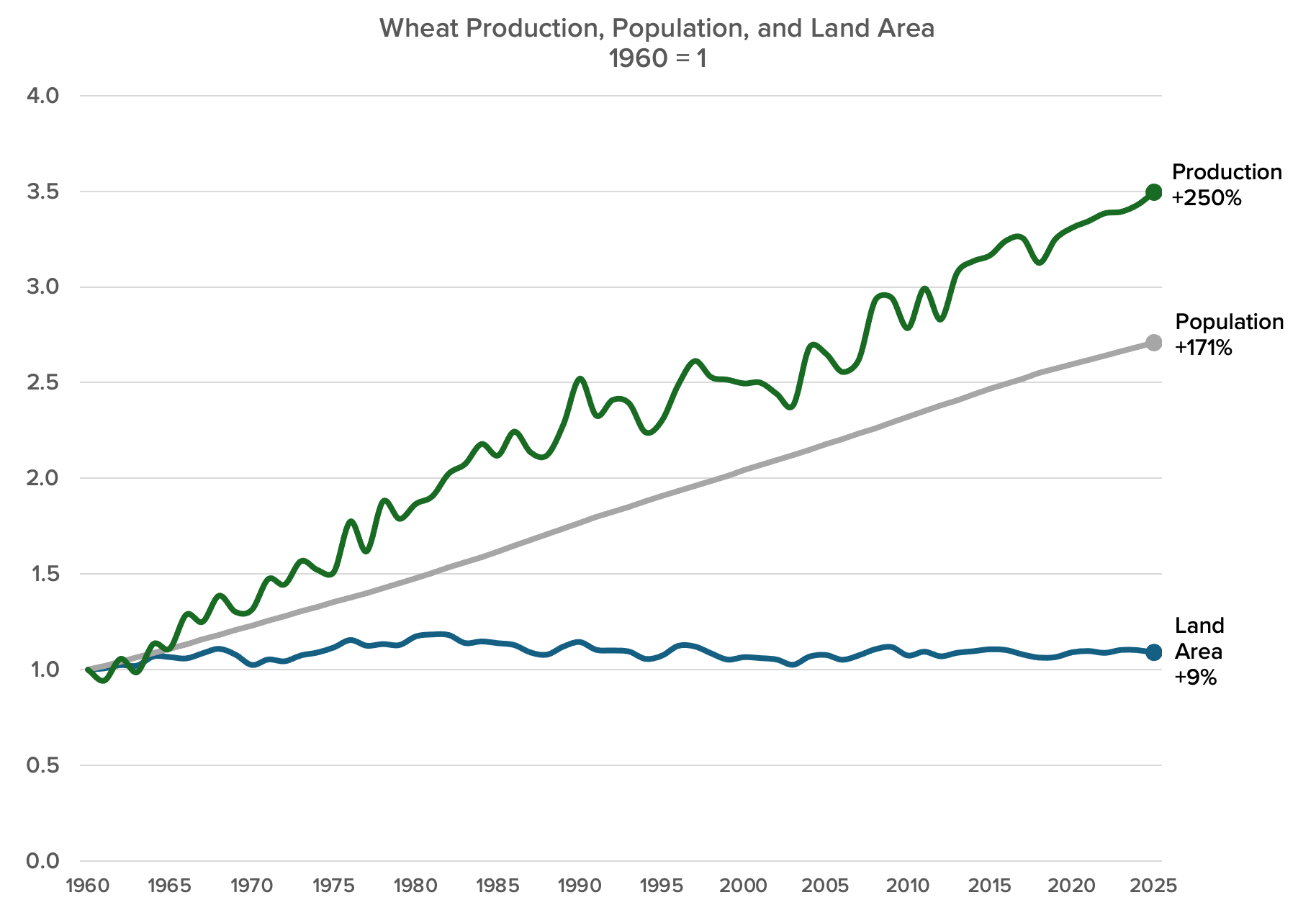
The US Department of Agriculture states that since 1960 wheat production has surged by 250 percent, while the world’s population grew by only 171 percent. So for every 1 percent increase in population, wheat production rose by nearly 1.5 percent. Ah but, you say, how much more land has been engulfed by wheat? Amazingly, land devoted to wheat production has only grown by about 9 percent. Wheat yields—the amount harvested per acre— has soared by 271 percent.
What about the cost? Since 1960, the price of wheat has fallen relatively speaking.
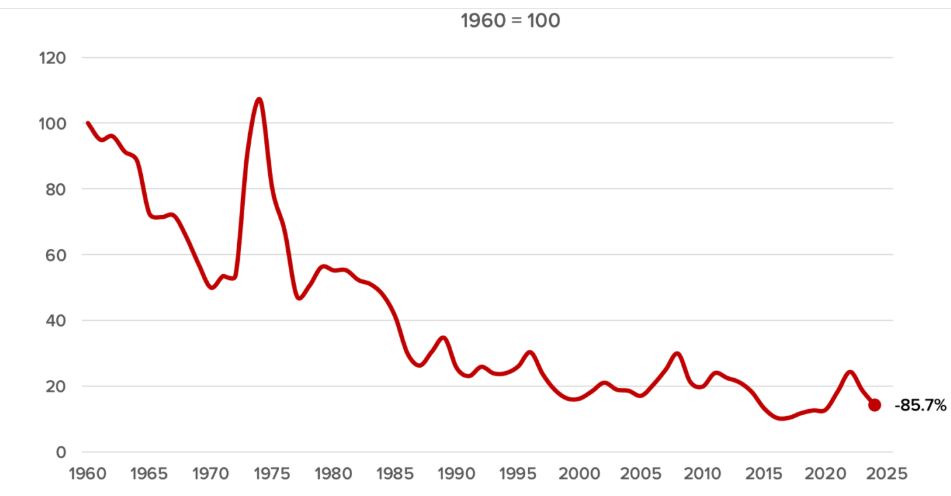
What that means is that the time it took to earn the money to buy a single bushel of wheat now buys almost seven bushels. Isn’t that just the most wonderful and heartening statistic? The big spike in the early 1970s was due to a perfect storm. Never mind the oil price shock the almost total failure of the Soviet grain harvest – itself part of a pattern of several years of worldwide failure – led to massive Soviet purchases. So much so that the price soared as can be seen from the chart. With the oil shock the dollar was effectively devalued and as ever markets race to adjust to the new reality. They also overshoot or undershoot, and here they probably overshot. The good old market sorted it out quite quickly.
Of course, it’s never been a straight line. Droughts, wars, politics and general human stupidity have caused prices to rise and fall. You only have to think of the war in Ukraine. It still produces some 20 million tons a year and ranks well up the top ten producers. More importantly it is a top 5 exporter and you can see the blip on the chart when Russia invaded.
Arguably, human innovation, open markets, and scientific doggedness have only made wheat more abundant. But it might just have been a big help in making the world’s population increase. Yes, wheat has grown more abundant. But in a strange quirk of fate, Malthus is almost certainly right. If food production (and don’t forget the rise of agricultural machinery helping things along) had not increased, quite possibly we would not have had the increase in world population. Remember Ethiopia and Band Aid? That was about a lack of food (and other things) which had a downward pressure on population. The West stepped up and sent massive amounts of food and things stabilised and the population increased again. So if Malthus could see our world today, I suspect he’d be pleased to see that his postulation was basically correct – even though not in the way he envisaged.
As it happens food production is one area where government interference is less prevalent. Any time anyone suggests that government diktat is required I ask them who supplies and directs London’s food supply. The answer is no one. The market does it all itself. Avocadoes short today? Price goes up a bit and the farmers send more to fill the gap. Too many bananas for the market to clear? Ripeners slow down the process and the supply drops. Nobody sits behind a desk and says “Right, we need 1 million avocadoes delivered to London today.” All the buyers of avocadoes are the ultimate arbiter of what happens – and the price they are prepared to pay to satisfy their desires.
Would you like to be dealing with an entity that serves and satisfies your every whim, or would you prefer to have to wait interminable months in pain even just to get told you have to wait?
I’m not talking about a private NHS in the first sentence nor about ANYTHING in Communist countries.
I’m talking about supermarkets in the UK as against the current NHS. The supermarkets are largely left alone to get on with it and a good thing too. The NHS on the other hand is burdened with interminable government interference and re-organisations. It’s no surprise that as there is no actual market to exert its stabilising influence, we get a shambles. The bit I currently like is AI related. Doctor’s surgeries are putting AI at the forefront of their appointment systems. The result is entirely predictable – no one can get an appointment. NHS England – terminated well over a year ago – still exists gobbling up resources and money though we were told £1billion would be saved. I’m willing to bet that as of now the actual saving is zero and quite possibly has moved into an additional cost.
If a department was useless in a supermarket it would be gone before you could blink. That’s the market at work. You ignore and shackle it at your peril.


