DCW Weekly Digest- Fintech & Crypto Digest


DCW Weekly Fintech & Crypto Digest
Week Ending 20 February 2026
Covering Digital Assets, Regulation, Cybersecurity, Quantum Computing & Innovation
Markets in distress, regulation accelerating, cybersecurity under siege. This week's digest captures a digital asset market defined by historic losses, Bitcoin trading near $65,000~$68,000 and Ethereum struggling below $2,000, while gold surges past $5,000 per ounce, drawing record global demand. Regulatory progress continues apace despite market headwinds, with the White House convening its third closed-door stablecoin meeting and the CLARITY Act gaining fresh momentum in Congress. The phishing epidemic drains $311 million in January 2026 alone. China issues sweeping restrictions on offshore yuan-pegged stablecoins. Quantum computing advances with D-Wave’s on-chip breakthrough signal, accelerating commercial timelines.
EXECUTIVE SUMMARY
Key headlines this week: UK FCA consultation deadline passes (12 February) as FSMA cryptoasset regime moves forward; California DFAL license applications open March 9; Poland vetoes MiCA implementation bill for a second time; Hong Kong grants first new exchange licence since June 2025; and darknet markets reported nearly $2.6 billion in aggregate flows in 2025. In cybersecurity, Adidas discloses 815,000-record breach, Ivanti zero-days are being actively exploited, and the CISA operates at reduced capacity following federal restructuring. On the innovation front, Wintermute launches institutional tokenised gold trading and World Liberty Financial unveils its first tokenised real estate RWA product linked to a Trump International Resort in the Maldives.
The week ending 20 February 2026 saw cryptocurrency markets sustain their steep post-January selloff, with Bitcoin consolidating in the $67,000~$68,000 range after plunging from $89,200 at its January peak. Bitcoin is now on course for its first-ever back-to-back declines in January and February, logging its worst first-50-day start to a year on record and sitting approximately 50% below its October 2025 all-time high of $122,000. Ethereum traded below the psychologically important $2,000 level, at approximately $1,981, while XRP held near $1.45 and Solana settled around $85. The broader CoinDesk 20 index dropped 3.7% on the week. The crypto Fear & Greed Index remained firmly in Extreme Fear territory, reflecting trader sentiment now described as the most negative since President Trump’s first election, with keywords such as ‘angry’, ‘frustrated’, and ‘offended’ reaching their highest recorded levels.
Regulatory developments dominated the week’s news. The UK government published the landmark Financial Services and Markets Act 2000 (Cryptoassets) Regulations 2026 (SI 2026/102), establishing a comprehensive regulatory framework for cryptoasset activities and setting a hard deadline of 25 October 2027 for full authorisation. The FCA’s three consultation papers on cryptoasset activities, admissions and disclosures, and prudential standards closed on 12 February 2026, with the regulator now processing industry feedback ahead of final policy statements expected mid-2026. In the United States, the White House hosted its third closed-door meeting between crypto advocates and banking groups over stablecoin yield, with Coinbase CLO Paul Grewal describing the tone as ‘cooperative’ but no deal being reached. Ripple CEO Brad Garlinghouse gave a 90% probability of a market structure bill passing by end of April.
Cybersecurity developments continued to escalate at alarming pace. January 2026 has now been confirmed as one of cryptocurrency’s darkest months for phishing and social engineering, with CertiK reporting $370 million in total losses, of which $311.3 million, or 84%, came from phishing attacks rather than protocol exploits. A single social engineering attack accounted for $284 million of those phishing losses, the largest single-victim theft in crypto history. Additionally, physical phishing letters impersonating hardware wallet providers Ledger and Trezor emerged as a new attack vector during early February. The CrossCurve DEX exploit on 2 February drained approximately $3 million from the cross-chain bridge, continuing a pattern of DeFi infrastructure attacks. Major corporate breaches also featured prominently, including the Adidas/Lapsus$ data compromise of 815,000 records, French government exposure of 1.2 million bank accounts, and critical Ivanti EPMM zero-day vulnerabilities being actively exploited against corporate networks.
Gold continued its extraordinary rally, surpassing $5,000 per ounce and drawing analysis from Deutsche Bank confirming a ‘genuine demand story’ supported by changing global order dynamics, central bank buying, and Chinese consumer accumulation ahead of Lunar New Year. Gold price forecasts ranged from $5,800 (ANZ) to $6,200 (UBS) by mid-2026, with more speculative targets reaching $20,000. The gold market’s resilience contrasts sharply with crypto’s ongoing weakness, reinforcing questions about the digital gold narrative and institutional capital allocation preferences during periods of macroeconomic and geopolitical uncertainty.
Quantum computing developments delivered a significant educational milestone with the publication of a comprehensive 20-term glossary for industry practitioners and investors, while D-Wave’s January 7th on-chip cryogenic control breakthrough continued to be digested by the market. The consensus view among major asset managers remains that cryptographically relevant quantum computers are unlikely before 2030, though the harvest-and-decrypt threat model and physical phishing campaigns combining traditional and digital attack vectors underscore the urgency of proactive security migration planning.
GENERAL NEWS
Gold Surpasses $5,000 ~ ‘There’s a Genuine Demand Story’
Gold traded at approximately $5,003.65 per ounce this week, cementing its position above the historic $5,000 threshold for the first time. Deutsche Bank analysts confirmed that the metal’s rally is underpinned by a ‘genuine demand story’ rather than purely speculative flows, citing the changing global order, sustained central bank accumulation, and shifting geopolitical dynamics as structural drivers. Goldman Sachs, in contrast, cautioned that gold’s rally does not yet signal a commodity supercycle, noting that the price rise is primarily driven by safe-haven flows and dollar weakness rather than broad industrial demand.
The global dimension of gold demand has intensified significantly. Chinese consumers dramatically accelerated gold purchases ahead of Lunar New Year, with households viewing the asset as a safety net amid persistent domestic economic uncertainty and a weakening yuan. World Gold Council China CEO Roland Wang described new shapes of gold demand in the country, with retail buyers favouring bars and coins over traditional jewellery. Ghana reported record gold output of 6 million ounces in 2025. India saw gold imports jump sharply in January, led by inflows from Switzerland and the UAE. Tanzania’s central bank approached its 20-tonne gold reserve target 18 months ahead of schedule. Saudi Arabia is forging a strategic partnership with Sudan to challenge Dubai’s longstanding dominance as Africa’s primary gold trading hub.
Price Forecasts: $5,800 to $20,000
The range of institutional gold price forecasts reflects extraordinary divergence in long-term outlooks:
- ANZ projects gold reaching $5,800 per ounce by Q2 2026
- AuAg Funds forecasts $6,000 gold and $133 silver by year-end, with 30% intra-year swings
- UBS strategist Maximilian Schnider targets $6,200 by June 2026 as volatility eases
- Options traders are positioning for $20,000 gold, a signal of tail-risk hedging behaviour rather than base-case investing
- Ray Dalio has publicly backed gold over crypto, warning that 'the world order has broken down' and that gold represents a more reliable hedge in periods of institutional fragility
Global Gold Demand: A World Turning to Physical Assets
Gold's rise is a genuinely global phenomenon, with consumption surging across Asia, the Middle East, Africa, and beyond:
- China: Households are doubling down on gold ahead of the Lunar New Year. According to the South China Morning Post, families view gold as a safety net amid economic uncertainty. Analysis from CNBC points to 'unruly speculators' fuelling frenzied demand in Chinese markets, with the World Gold Council China CEO describing a structural shift in domestic savings behaviour.
- India: Gold imports jumped sharply in January, led by Switzerland and UAE shipments. India is unlikely to offer gold concessions in GCC trade talks given the surge in UAE-origin imports, creating diplomatic tension around tariff arrangements.
- Singapore: Residents are flocking to gold jewellers and bullion dealers despite record-high prices, with a Chinese New Year spending surge pushing inventory shortfalls. Singapore's Chang Cheng F&B Group distributed over 100 gold plaques worth more than $500,000 to long-serving employees, an unusual but symbolic corporate use of physical gold.
- Saudi Arabia: Entering the African gold trade through a strategic partnership with Sudan, potentially challenging Dubai's long-standing dominance as a hub for African gold flows.
- Tanzania: The Bank of Tanzania has neared its 20-tonne gold reserve target 18 months ahead of schedule.
- Türkiye: The country's gold reserves are approaching $134 billion, with the fastest accumulation rate among OECD nations.
- Ghana: Gold output hit a record 6 million ounces in 2025.
- UK: South Asian jewellers in Britain are reporting booming business as consumers purchase 22-carat gold bars and coins or liquidate unworn jewellery. Sky News secured rare access to the Bank of England's gold vaults, drawing public attention to the scale of the world's largest single gold deposit.
- United States: Reporting of 'unseen forces' moving significant quantities of gold back to the US, a development linked to tariff uncertainty and concerns about custodial risk under geopolitical stress.
- Japan: Gold smuggling is 'running rampant' as the arbitrage opportunity between domestic and international prices widens. In a contrasting story, a mystery donor gave a Japanese city $3.6 million in gold bars to fund water infrastructure repairs.
- Vietnam: Authorities introduced fines of up to $12,000 for illicit gold transactions as part of a black market crackdown. The Ministry of Finance clarified that a 0.1% tax on gold bar transactions, effective July 1, is designed to curb speculation.
- Indonesia: The gold price surge is squeezing local jewellery manufacturers as input costs spike. Thailand: Villagers in Nong Khai are panning for gold in the low-water Mekong River. Tajikistan is deploying gold ATMs for public bullion transactions.
⚠ DCW Practitioner Note: Gold's ascent above $5,000 has created a secondary financial stress: insurance capacity constraints. The Financial Times reports that vault operators are reducing coverage and shifting reserves between sites as the replacement cost of holdings has exceeded traditional insurance programme limits, a compliance and operational risk consideration for custodians holding physical gold on behalf of clients.
STABLECOINS & PAYMENT INNOVATION
Crypto Debanking: Systemic and Persistent
Despite near-universal endorsement of crypto's institutional credentials at the policy level, banking access remains one of the most significant operational barriers for the industry. A January 2026 report from the UK Cryptoasset Business Council found that approximately 40% of payments to cryptocurrency exchanges were being blocked or delayed by UK banks, with 80% of exchanges reporting increased friction over the past 12 months.
The report warns that blanket transaction bans and payment caps are frequently applied without reference to the legal registration status of the receiving exchange, a pattern inconsistent with principles-based regulation and potentially exposing banks to discrimination claims.
Panos Mekras, co-founder and CEO of Anodos Labs, illustrated the human dimension of this problem: "I tried to send money from an exchange to Revolut, and they froze my account for three weeks. I had no access to my funds during that time." Mekras began navigating crypto banking restrictions in Greece in the late 2010s and reports that the same barriers persist today despite the sector's mainstreaming.
Wintermute Launches Institutional Tokenised Gold Trading
Crypto market maker Wintermute has launched institutional over-the-counter trading for tokenised gold products PAXG and XAUT, marking a significant development in the convergence of traditional precious metals markets with blockchain-based asset management. Wintermute CEO Evgeny Gaevoy projected the tokenised gold sector could expand 2.8x to reach $15 billion in 2026, even as broader crypto markets remain subdued. This initiative reflects the broader convergence between gold's physical resurgence and blockchain's capacity to deliver fractional, transferable, and programmable exposure to the metal, a development of particular significance for emerging market institutional investors who have historically faced barriers to direct gold custody, and growing institutional interest in on-chain alternatives to traditional gold ETFs and physical storage, with tokenised gold offering 24/7 liquidity, fractional ownership, and programmable settlement capabilities that conventional gold instruments cannot match.
White House Stablecoin Yield Negotiations Continue, No Deal Yet
The White House hosted its third closed-door meeting on stablecoin yield on Thursday, 19 February 2026, bringing together crypto advocates, including Ripple, the Blockchain Association, and Crypto Council for Innovation, alongside major bank trade associations. Crypto Council for Innovation’s Ji Hun Kim described the hours-long meeting as ‘constructive’, noting that ‘the conversation built upon previous meetings to establish a framework that serves American consumers while reinforcing US competitiveness.’ Coinbase Chief Legal Officer Paul Grewal characterised the dialogue as ‘constructive’ and the tone ‘cooperative,’ though the source familiar with the meetings told The Block that no compromise was reached and the White House appeared intent on keeping participants there ‘until a deal is made.’
The core yield dispute remains the central sticking point: banks argue that allowing stablecoin yields would drain deposits from traditional institutions and hurt community banks, while crypto firms maintain that restricting such yields stifles innovation. The GENIUS Act, signed into law in July 2025, bars stablecoin issuers from paying direct interest to holders, but does not prohibit third-party platforms such as Coinbase from offering rewards. An amendment to the Senate Banking Committee’s draft would allow crypto exchanges to offer yield on stablecoins if the customer takes certain actions such as selling their stablecoins, but not if the stablecoin simply sits in the customer’s account. During the prior White House meeting, banks laid out ‘prohibition principles’ calling for a broad ban on any financial or non-financial benefits tied to holding payment stablecoins, which crypto stakeholders strongly opposed. The Digital Chamber has released its own framework more closely aligned with the Senate Banking Committee’s draft.
Ripple CEO Brad Garlinghouse gave a 90% probability of a bill passing by end of April on Fox Business, citing White House pressure. ‘The White House is pushing hard on this, and I think that is a big reason why it will get done,’ Garlinghouse said. Polymarket’s prediction market for the CLARITY Act settling to 72% probability as of Thursday morning, after ranging between 54% and 85% during recent days. Senator Bernie Moreno issued a stark warning that Congress faces a pivotal 90-day deadline to pass landmark cryptocurrency legislation, creating urgency heading into spring 2026.
US REGULATORY DEVELOPMENTS
CLARITY Act Gains Momentum as SEC and CFTC Align
US lawmakers and regulators are accelerating the push for a clearer crypto rulebook as the Senate advances market-structure legislation and the SEC signals deeper coordination with the CFTC ahead of potential reforms. The CLARITY Act, which would divide jurisdiction over crypto markets between the CFTC and SEC and establish new regulatory standards, has gained renewed momentum following the Senate Agriculture Committee’s passage of the Digital Commodity Intermediaries Act in late January. The convergence of the two regulatory bodies’ positions on digital asset classification represents a significant development toward achieving the holistic regulatory clarity that the industry has long sought.
The CFTC has asserted exclusive federal authority over prediction markets in a new amicus brief submitted to the US Court of Appeals for the Ninth Circuit in a case involving Crypto.com and the state of Nevada. The brief clashes with state-level assertions of regulatory authority over what regulators characterise as sports betting contracts. Tennessee’s cease-and-desist orders against Kalshi, Polymarket, and Crypto.com ,and a federal judge’s temporary blocking of Tennessee from barring Kalshi’s sports event contracts ,illustrate the fractured regulatory landscape for prediction markets that the CFTC’s brief seeks to resolve by establishing clear federal primacy.
Coinbase CEO Brian Armstrong publicly attributed the legislative impasse on market structure to banking trade groups rather than individual banks, arguing that trade associations are taking more extreme positions than their member institutions to protect legacy business models from stablecoin competition. The US is simultaneously slashing its crypto anti-money laundering oversight capacity, with federal data obtained by the International Consortium of Investigative Journalists revealing that the number of federal investigators assigned to review AML safeguards at cryptocurrency exchanges plummeted in 2025 to the lowest level since at least 2017. This reduction in enforcement capacity coincides with accelerating institutional adoption and a growing compliance burden from GENIUS Act implementation.
SEC-CFTC Coordination: Project Crypto
In a significant development, CFTC Chairman Michael Selig delivered a major crypto policy speech in coordination with SEC Chair Paul Atkins on 29 January, announcing that the CFTC will partner with the SEC on 'Project Crypto', a unified approach to federal oversight of crypto asset markets. Chairman Selig stated: "America's financial regulators must modernize and harmonize their approach to regulation to future-proof our markets for the innovations of tomorrow."
The SEC has also issued updated FAQs (19 February) confirming that broker-dealers may treat proprietary positions in payment stablecoins as having a 'ready market' with a 2% haircut for net capital calculation purposes under Rule 15c3-1, a significant step toward integrating stablecoins into regulated broker-dealer operations. Commissioner Peirce highlighted the significance of this guidance.
The SEC's Division of Corporation Finance also issued a Tokenization Statement on 28 January, elaborating on its taxonomy of tokenised securities and reaffirming that "securities, however represented, remain securities, economic reality trumps labels."
California Sets Crypto Licensing Deadline
California is moving forward with state-level crypto oversight, confirming that firms serving California residents must secure a Digital Financial Assets Law licence or apply for one by 1 July 2026. Applications open on 9 March 2026 through the Nationwide Multistate Licensing System. The DFAL, signed by Governor Gavin Newsom in 2023, creates a comprehensive licensing regime covering exchanges, custodians, and crypto kiosks. Joe Ciccolo of the California Blockchain Advocacy Coalition noted that California’s status as the fourth-largest economy in the world means its regulatory choices inevitably carry global weight, and that clearer rules could attract institutional capital while warning that smaller operators may exit rather than meet stricter standards ,echoing the business disruption that followed New York’s BitLicense implementation.
Federal Reserve Working Paper on Crypto Initial Margin
On 11 February, Federal Reserve Board staff published a working paper examining the prospective classification of cryptocurrency risks within the ISDA Standardised Initial Margin Model (SIMM) framework for uncleared derivatives markets. This technical analysis reflects growing regulatory consideration of crypto as a collateral asset class within traditional derivatives infrastructure.
Crypto AML Oversight: A Troubling Reduction
The International Consortium of Investigative Journalists has reported, via The Washington Post, that the number of federal investigators assigned to review anti-money laundering safeguards for cryptocurrency exchanges 'plummeted last year to the lowest level since at least 2017', even as crypto use in the United States has surged. This pattern creates a structural tension between the administration's innovation agenda and the integrity of financial crime controls.
CFTC Claims Exclusive Federal Authority Over Prediction Markets
The CFTC submitted an amicus brief to the US Court of Appeals for the Ninth Circuit asserting exclusive federal authority over prediction markets, in a case involving Crypto.com and the state of Nevada. This submission follows Tennessee's cease-and-desist orders against Kalshi, Polymarket, and Crypto.com, orders that have been temporarily blocked by federal court injunction. The jurisdictional tension between state gambling law and federal commodities regulation is escalating and will likely require legislative resolution.
CYBERSECURITY & SCAMS
The Phishing Epidemic: $311 Million Lost in January 2026 Alone
January 2026 delivered a watershed moment in cryptocurrency security, confirming that attackers have decisively pivoted from code exploits to human psychology as their primary vector. According to blockchain security firm CertiK, total cryptocurrency losses in January 2026 reached approximately $370 million ,the highest monthly total in 11 months since the February 2025 Bybit hack. Of that total, phishing and social engineering attacks accounted for $311.3 million, representing nearly 84% of all losses and outpacing protocol hacks by more than 3.5 to 1. The 16 documented protocol hacks in January resulted in just $86.01 million in losses, a modest 13.25% increase from December 2025 that underscores improving smart contract security while highlighting the vulnerability of human decision-making.
The most devastating single incident was a social engineering attack on 10 January 2026, in which a single wallet holder lost $284 million worth of Bitcoin and Litecoin. On-chain investigator ZachXBT confirmed the theft, which represented more than 80% of all January phishing losses and dwarfed every protocol exploit combined. The attacker exploited trust and operational access rather than any code vulnerability, manipulating the victim into surrendering wallet recovery information. This incident sets a disturbing precedent for the scale achievable by sophisticated social engineers operating against high-net-worth crypto holders.
Physical phishing attacks emerged as a particularly alarming new vector in early February 2026. Scammers began sending official-looking physical mail impersonating hardware wallet providers Ledger and Trezor, printed on branded letterhead, claiming users must complete a ‘mandatory authentication update’. Each letter included a QR code leading to a fake setup website requesting the recipient’s wallet recovery phrase. The campaign’s timing was calculated to exploit confusion around real security updates from hardware wallet providers; fake Trezor letters set a deadline of 15 February 2026, coinciding with legitimate Trezor firmware releases. These campaigns likely leverage customer data from past breaches, representing the convergence of traditional physical mail fraud with crypto-specific attack methodologies.
Address poisoning attacks also intensified, with attackers creating wallet addresses that closely resemble frequently used addresses and sending small ‘dust’ transactions to contaminate victims’ transaction histories. A Carnegie Mellon University CyLab study published in January 2026 identified more than 270 million address poisoning attempts targeting over 17 million wallets between 2022 and 2024. In December 2025, a single trader lost $50 million in USDT through this method; in January 2026, another investor lost $12.25 million. The attack exploits wallet interfaces that display only the first and last few characters of addresses, making carefully crafted near-identical addresses nearly impossible to distinguish under normal usage conditions.
Major Corporate and Infrastructure Breaches
The broader cybersecurity landscape was marked by several high-profile corporate data breaches and infrastructure attacks during the Feb 12-20 period. Sportswear giant Adidas confirmed it is investigating a potential data breach at an independent licensing partner after the hacker collective Lapsus$ claimed to have accessed 815,000 rows of sensitive information from the company’s extranet. The French government disclosed that 1.2 million bank accounts were exposed in a breach, affecting a significant portion of the French retail banking population. Dior, Louis Vuitton, and Tiffany were collectively fined $25 million in South Korea following data breaches affecting luxury goods customers.
Critical infrastructure attacks escalated with the active exploitation of two newly discovered zero-day vulnerabilities ,CVE-2026-1281 and CVE-2026-1340 ,targeting Ivanti Endpoint Manager Mobile, a widely deployed mobile device management platform. Security researchers warned that attackers can remotely execute code on affected servers without authentication, user interaction, or stolen credentials, placing corporate networks at significant risk. German rail giant Deutsche Bahn was hit by a large-scale DDoS attack disrupting rail services. Dell RecoverPoint systems were exploited by Chinese state-affiliated hackers. Nearly one million user records were compromised in a Figure data breach. Password manager vulnerabilities allowing vault compromise were publicly disclosed, and almost 500,000 VKontakte accounts were hijacked through malicious Chrome extensions.
The Palo Alto Networks acquisition of Koi in a reported $400 million transaction and Venice Security’s emergence from stealth with $33 million in funding reflected continued cybersecurity industry investment in AI-driven vulnerability management, with Cogent Security raising $42 million for its AI-powered platform. Dragos reported that three distinct threat groups began targeting industrial control systems and operational technology in 2025, a trend expected to intensify throughout 2026. CISA navigated a period of reduced staff following DHS restructuring under the Trump administration, raising concerns about the US government’s capacity to respond to escalating cyber threats targeting critical infrastructure.
Darknet Market Activity and Criminal Ecosystem
Darknet market activity remains resilient, with aggregate flows reaching nearly $2.6 billion in 2025 according to Chainalysis analysis. While crypto-enabled drug markets persist despite enforcement actions, blockchain data is revealing critical shifts in public health trends and market dynamics. Fentanyl-related on-chain flows dropped sharply, aligning with reduced interdictions and opioid overdose deaths, positioning blockchain analytics as a vital early warning signal for public health authorities. Transaction size analysis of Canadian stimulant markets showed larger crypto purchases correlate with worse health outcomes, while smaller transactions show no meaningful association, providing actionable intelligence for harm reduction interventions.
TorZon has risen to dominance following the closure of Abacus Market in July 2025, demonstrating that enforcement actions against specific darknet marketplaces typically cause temporary disruption followed by consolidation around alternative platforms rather than permanent reduction in market activity. Fraud shop activity declined year-over-year, driven by enforcement pressure and a shift toward custodial merchant services. Chinese-language fraud shops are pivoting toward higher-value, wholesale-focused operations, mirroring the industrialisation trend identified in Chainalysis’s broader analysis of Chinese-language money laundering networks.
Ivanti EPMM Zero-Day: Active Exploitation Confirmed
Two newly discovered zero-day vulnerabilities, CVE-2026-1281 and CVE-2026-1340, are being actively exploited against organisations using Ivanti Endpoint Manager Mobile (EPMM), a widely deployed mobile device management platform. Security researchers warn that attackers can execute code on affected servers remotely, without authentication, user interaction, or stolen credentials. The attacks have been traced back to at least July 2025, indicating a prolonged period of covert exploitation. Organisations using Ivanti EPMM must treat this as a critical-priority patching event.
Dell RecoverPoint Zero-Day: Chinese Hackers
Chinese state-linked threat actors have exploited a zero-day vulnerability in Dell RecoverPoint disaster recovery infrastructure. The use of enterprise backup and recovery systems as attack vectors represents an escalating and particularly dangerous threat given that these systems often hold comprehensive copies of organisational data.
Password Managers Vulnerable to Vault Compromise
Security researchers have identified vulnerabilities in several popular password management platforms that could allow vault compromise under specific attack conditions. Users who rely on password managers for crypto wallet seed phrases and private key storage should review the security posture of their chosen platform. This vulnerability class is of heightened concern for digital asset holders, given the catastrophic consequences of key exposure.
CISA: Navigating Reduced Capacity
The Cybersecurity and Infrastructure Security Agency (CISA) is operating with reduced staff following restructuring within the Department of Homeland Security. The timing of this reduction, amid an active and escalating threat environment, is generating significant concern within the cybersecurity community. Reduced government capacity to coordinate responses to major incidents creates additional burden for private sector defenders.
New Android Malware Found on Thousands of Devices
A previously undetected Android malware strain has been discovered across thousands of devices, with researchers indicating command-and-control infrastructure consistent with financially-motivated threat actors targeting digital banking applications and crypto wallets. Mobile device security posture remains a critical vulnerability surface for the digital asset sector.
Industry Investment & Responses
- Venice Security has emerged from stealth with $33 million in funding for institutional-grade digital asset security infrastructure.
- Cogent Security has raised $42 million for AI-driven vulnerability management, reflecting the growing market for automated detection and remediation.
- VulnCheck has raised $25 million in Series B funding to scale vulnerability intelligence services.
- Palo Alto Networks is acquiring Koi in a reported $400 million transaction, continuing the consolidation wave in enterprise cybersecurity.
- Three new threat groups began targeting industrial control systems (ICS/OT) in 2025, according to Dragos, an alarming development for critical infrastructure operators.
- A suspect linked to Phobos ransomware has been arrested in Poland following an international law enforcement operation.
⚠ DCW Practitioner Note: The convergence of CISA operating at reduced capacity, three new ICS/OT threat groups, active zero-day exploitation across enterprise mobility platforms, and continued North Korean state-sponsored crypto theft represents a threat environment that demands proactive organisational response. DCW members should review business continuity plans and third-party vendor security assessments as a priority action for Q1 2026.
DIGITAL ASSET MARKETS
Bitcoin Logs Worst First 50-Day Start to a Year on Record
Bitcoin extended its post-January selloff through the week of 12-20 February, trading in a $66,900–$69,200 range before closing near $67,500 on Wednesday 18 February. The cryptocurrency is now on course for its first-ever back-to-back monthly declines in January and February, logging its worst first-50-day start to a year on record. From October’s all-time high of $122,000, Bitcoin has retraced approximately 45%, with the January 30th breakdown below the 100-week moving average at $87,145 establishing the technical framework for the current bearish trend structure. The Crypto Fear & Greed Index remained firmly in Extreme Fear territory, with Sentiment data revealing that negative trader sentiment, expressed through keywords such as ‘angry’, ‘frustrated’, and ‘offended’ , reached its highest levels since Trump’s first election.
Technical analysts identify the $65,000–$67,000 zone as critical near-term support, with a sustained break below that level potentially triggering a cascade toward the $60,000–$62,000 range established as year-to-date lows. The next major macro catalyst is US PCE inflation data on 28 February 2026. Key resistance sits at the 7-day simple moving average near $70,000, with the 50-day EMA at approximately $80,000 representing the threshold that would need to be reclaimed to neutralise the short-term bearish structure. Glassnode’s weekly market report found BTC range-bound under pressure, with the Realised Price of approximately $55,000 acting as deep support and the broken True Market Mean of roughly $79,000 marking the ceiling, with the $60,000–$69,000 band acting as the main demand cluster absorbing recent selling.
Bitcoin derivatives markets showed continued defensive positioning, with the one-week 25-delta options skew climbing to 23% even as call dominance remained steady at 55%, implying some bottom-fishing activity despite elevated fear. CoinGlass reported $297 million in 24-hour liquidations, with a 77-23 long-short split. The average Bitcoin ETF investor now sits on a 20% paper loss, leaving the market vulnerable to capitulation selling if prices slide further, according to a Wintermute trader. Paul Howard of Wincent noted that crypto needs a ‘decisive shift’ to attract capital back from AI and commodities sectors, where significant inflows have been concentrated throughout the February weakness.
Metaplanet CEO Simon Gerovich defended the company’s Bitcoin treasury strategy and disclosure standards, rebutting critics who questioned its options trading model amid the broader market selloff. Eric Trump reiterated his claim that Bitcoin is ‘just getting started on its road to $1 million’, acknowledging near-term volatility while arguing its upside potential outweighs the risks with prices hovering below $70,000. Susquehanna-backed market maker Blockfills announced it was up for sale after suffering $75 million in lending losses, temporarily suspending client deposits and withdrawals.
Ethereum and Altcoins Face Continued Pressure
Ethereum traded at approximately $1,981 on 17 February, falling 0.85% on the day and remaining trapped in a $1,800–$2,100 consolidation range ,the lowest consolidation since May 2025. The psychological $2,000 level continues to act as a pivot point, with bulls and bears contesting control around this key threshold. Ethereum has now underperformed Bitcoin on a relative basis since the January 30 market breakdown, with the ETH/BTC ratio declining further as capital rotated toward Bitcoin’s perceived defensive positioning. Vitalik Buterin changed his stance on prediction markets during the week, warning of a ‘cursed’ slide into what he termed ‘corposlop’ ,a critique of over-centralised prediction market infrastructure that lacks genuine decentralisation properties.
Solana’s Alpenglow consensus upgrade continued to attract developer interest, with Anza ,a spinoff from Solana Labs ,developing the protocol that would replace Solana’s current Proof of History and Tower BFT systems. Alpenglow’s two key components, Votor (targeting 100–150 millisecond block finality) and Rotor (a more efficient data relay protocol), could substantially accelerate transaction throughput and on-chain activity if successfully implemented. XRP held near $1.45, BNB remained above $615, and Dogecoin tested $0.10 support, with the broader altcoin market exhibiting fragmented performance as momentum concentrated selectively in privacy technology and deflationary protocols.
Key drivers of the correction include: a hawkish Federal Reserve posture maintaining the federal funds rate near 3.75% with inflation sticky around 2.4%; significant outflows from Bitcoin and Ethereum spot ETFs; IRS Form 1099-DA compliance obligations forcing liquidations ahead of tax season; and a late-January leverage flush that saw $5.4 billion in leveraged long positions liquidated across 72 hours
Market Performance Summary (WE 20 February 2026):

US Supreme Court Tariff Ruling: A Volatility Catalyst
Market participants are watching closely for Friday 20 February's US Supreme Court ruling on tariffs imposed under emergency powers, a decision that could inject significant volatility across risk assets. When the court delayed a similar ruling in early January, Bitcoin surged more than $2,000 in under an hour, briefly approaching $92,000, while approximately $39 million in short positions were liquidated. Paul Howard, Director at Wincent, notes that crypto needs a 'decisive shift' to attract capital back from AI and commodities.
Tokenised Assets and Institutional Developments
Despite the challenging market environment for native crypto assets, the tokenised real-world asset (RWA) sector is maturing rapidly. On-chain RWAs now stand at $24 billion in value, supported by $365 billion in underlying assets, a market that industry analysts broadly expect to continue growing regardless of crypto market conditions.
Key developments this week:
- World Liberty Financial (WLFI), co-founded by the Trump family, unveiled plans to tokenise loan revenue from Trump International Hotel & Resort in the Maldives, in partnership with Securitize and DarGlobal PLC. The offering targets accredited investors under Regulation D and S exemptions and will be supported as collateral on WLFI's DeFi platform. The announcement was made at the World Liberty Forum at Mar-a-Lago, attended by Goldman Sachs, Nasdaq, and Franklin Templeton executives.
- WLFI also announced a partnership with Apex Group to pilot its USD1 stablecoin for fund settlement operations, an integration of blockchain-based payments into traditional fund administration.
- Galaxy Digital met with the SEC's Crypto Task Force and is exploring the tokenisation of its own equity, a development that would represent a significant precedent for publicly traded firms.
- WisdomTree's application to launch a tokenised money market fund is pending SEC decision by end of February 2026.
- NYSE has announced plans for 24/7 blockchain-based trading of tokenised stocks, pending regulatory approvals.
- Kraken's xStocks platform has surpassed $25 billion in tokenised trades in under eight months.
Kraken’s xStocks platform hit $25 billion in tokenised equity trades in under eight months, a milestone that underscores the rapid adoption of tokenised traditional assets despite the broader crypto market’s weakness. The US Federal Reserve published research praising prediction markets, describing platforms like Kalshi as valuable to policymakers and researchers, adding academic credibility to a sector under regulatory scrutiny. Peter Thiel’s complete exit from his Ethereum bet , confirmed by a 17 February SEC filing showing 0.00% beneficial ownership as of 31 December 2025, attracted significant market attention as a signal of institutional repositioning away from the second-largest cryptocurrency.
Yorkville America Equities filed with the SEC to launch Truth Social-branded Bitcoin and Ether ETFs, as well as a Truth Social Cronos Yield Maximizer ETF that would invest in and stake Cronos tokens. The proposed funds would launch in partnership with Crypto.com for custody, liquidity, and staking services. Robinhood’s development of its own Ethereum Layer-2 drew public attention, particularly given Vitalik Buterin’s cooling sentiment toward L2 architectures. Spark, incubated by Sky, debuted institutional lending products that link off-chain custodied assets to DeFi markets, helping manage over $9 billion in stablecoin liquidity, and the SPK token outperformed the broader crypto market during the week.
SEC Chair Paul Atkins stated: "Tokenization has the potential to transform our financial markets, increasing transparency and creating greater predictability. Under my leadership, the SEC is embracing innovation and working to provide clarity for market participants." BlackRock COO Rob Goldstein described blockchain as "the biggest financial breakthrough since double-entry bookkeeping."
⚠ DCW Practitioner Note: The current crypto market drawdown, however painful for holders, is creating the technical and regulatory foundations for a more institutionally robust sector. The convergence of SEC clarity on tokenised securities, CFTC-SEC coordination, and the $24 billion RWA market reaching genuine scale suggests that the next market cycle may be characterised by significantly deeper institutional participation.
INNOVATION & TECHNOLOGY DEVELOPMENTS
Science Prediction Markets and the Sybil Resistance Imperative
Prediction markets continued their evolution toward mainstream financial infrastructure this week, attracting both regulatory scrutiny and academic validation. Tennessee’s cease-and-desist orders against Kalshi, Polymarket, and Crypto.com over sports event contracts, followed by a federal judge temporarily blocking Tennessee from enforcing its order against Kalshi, illustrate the jurisdictional tensions that will shape prediction market regulation throughout 2026. A Columbia-affiliated analysis of Polymarket’s on-chain activity concluded that artificial trading accounted for an average of approximately 25% of buying and selling over the past three years, raising fundamental questions about the integrity of displayed price signals.
The challenge of Sybil resistance, preventing a single actor from creating many fake accounts to impersonate a crowd and distort market outcomes, is particularly acute for scientific prediction markets, where manufactured consensus could influence research funding and replication priorities. Existing approaches include credential aggregation (Human Passport), social-graph uniqueness verification (BrightID), curated registries with dispute processes (Proof of Humanity), and privacy-preserving biometrics (Humanode Biomapper). None are perfect, but each raises the cost of synthetic participation above the level of purely on-chain systems where influence scales with wallet count. The US Federal Reserve’s research calling prediction markets valuable to policymakers provides important institutional validation at precisely the moment when regulatory frameworks are being contested at state and federal levels.
AI and Blockchain Convergence Accelerates
The Ethereum ERC-8004 standard’s deployment in January 2026 continues to generate discussion about the network’s positioning as settlement infrastructure for AI agent interactions. The standard’s identity registries, reputation systems, and validation frameworks address the fundamental challenge of establishing trust between autonomous agents without human intermediaries. As AI capabilities advance and organisations deploy autonomous agents for tasks ranging from financial analysis to supply chain management, the demand for blockchain-based credentialisation and interaction settlement is expected to grow substantially throughout 2026.
Major banks’ ongoing diversification away from OpenAI as their primary large language model provider continued to reshape the enterprise AI landscape. The shift reflects institutional risk management considerations including vendor lock-in, data sovereignty requirements under European and Asian regulatory frameworks, and improving capabilities from alternative providers including Anthropic, Google, and open-source models deployable in private cloud environments. This diversification trend creates opportunities for crypto-native AI projects that address data sovereignty concerns inherent in centralised AI providers.
OpenAI and crypto investment firm Paradigm jointly unveiled EVMbench, a standardised framework for smart contract security evaluation. This collaboration signals a deepening intersection between frontier AI development and blockchain security, with implications for automated auditing and real-time threat detection in DeFi protocols.
Robinhood Layer 2: Four Million Transactions in First Week
Robinhood's newly launched Layer 2 blockchain testnet processed four million transactions in its first week of operation, according to CEO Vlad Tenev. This performance benchmark suggests significant retail demand for lower-cost, higher-throughput blockchain infrastructure, a demand that could accelerate Robinhood's transition from a crypto brokerage into a full crypto infrastructure provider.
QUANTUM COMPUTING: 20-TERM PRACTITIONER GLOSSARY
Quantum computing is reshaping the boundaries of what computers can do, but the field comes with dense vocabulary that can be a barrier to informed decision-making. Whether you are a compliance officer assessing post-quantum cryptography migration timelines, an investor evaluating quantum companies, or a technology strategist exploring quantum SDKs, these 20 terms form the conceptual core you need.


Industry Consensus on Timeline: The prevailing expert view is that cryptographically relevant quantum computers, capable of running Shor's algorithm at the scale required to break RSA or elliptic curve cryptography, are unlikely before 2030. However, the 'harvest now, decrypt later' threat model means organisations handling data with long-term confidentiality requirements should begin post-quantum cryptography migration planning now. NIST's PQC standards provide the framework for this transition.
GLOBAL REGULATORY UPDATES
UK Publishes Landmark FSMA Cryptoassets Regulations 2026
On 4 February 2026, the United Kingdom published the Financial Services and Markets Act 2000 (Cryptoassets) Regulations 2026 (SI 2026/102), alongside an explanatory memorandum, establishing a comprehensive regulatory framework for cryptoasset activities under FSMA. The Regulations set a hard deadline of 25 October 2027 for full implementation, before which any business carrying out regulated activities, including dealing, arranging, or issuing stablecoins, must hold a full FCA licence or risk committing a criminal offence. The legislation introduces a comprehensive market abuse framework, explicitly bans public offers of qualifying cryptoassets unless a specific exemption applies, and clarifies that tokenised versions of traditional assets such as equities and bonds are excluded from the new definitions and remain under existing securities laws.
HM Treasury estimated the initial cost of compliance at £24 million, with firms required to begin substantive preparation well ahead of the FCA’s application gateway opening in September 2026. The FCA’s three major consultation papers on cryptoasset activities (CP25/40), admissions and disclosures and market abuse (CP25/41), and prudential standards (CP25/42) all closed on 12 February 2026 ,a significant milestone in the UK’s regulatory development process. The FCA will process industry responses and publish final policy statements during 2026, providing the detailed rulebook firms need to prepare compliance frameworks. In January 2026, the FCA published CP26/4, setting proposed criteria for when stablecoin issuers and cryptoasset custodians should be classified as SM&CR Enhanced firms, with the stablecoin threshold set at £65 billion in backing assets calculated as a three-year rolling average.
The Bank of England published a speech by Executive Director Sasha Mills on 29 January 2026, identifying tokenised collateral as its second key innovation priority for 2026, alongside systemic stablecoins and the Digital Securities Sandbox. The FCA’s continued emphasis on cross-border cooperation with international law enforcement reflects recognition that many bad actors and platform providers are based outside the UK, requiring sustained multilateral coordination for effective enforcement. Firms should note that applications submitted after 25 October 2027 without prior gateway submission will not benefit from transitional arrangements, creating a binary compliance cliff edge that makes early engagement with the FCA authorisation process essential.
China Issues Sweeping Restrictions on Offshore Stablecoins
Eight Chinese government agencies, including the People’s Bank of China, issued a strict coordinated notice promising to tighten restrictions on virtual currency interactions. The directive explicitly prohibits domestic entities and their controlled overseas subsidiaries from issuing virtual currencies without official approval, with particular targeting of ‘unauthorised offshore issuance’ of yuan-pegged stablecoins. Domestic entities must also subject tokens backed by real-world assets to strict vetting. The directive maintains China’s traditional stance of protecting monetary sovereignty and the digital yuan (e-CNY) from private sector competition, whilst the inclusion of RWA within a legal framework is interpreted by some market observers as a potential future opening for regulated tokenisation ,subject to strict compliance with government approval processes.
Hong Kong: First New Exchange Licence Since June 2025
On 13 February, Hong Kong's Securities and Futures Commission granted a Virtual Asset Trading Platform licence to Victory Fintech (VDX), an affiliate of publicly listed Victory Securities. This is the first new addition to Hong Kong's approved exchange list since June 2025, bringing the total number of licensed platforms to 12. VDX received authorisation for Type 1 (dealing in securities) and Type 7 (automated trading services), with its custody affiliate receiving authorisation under Hong Kong's AMLO framework.
Poland, Japan, and Emerging Market Developments
Poland’s President vetoed the country’s crypto bill for a second time, representing a significant setback for Central European crypto market development and reflecting persistent political disagreement about the appropriate regulatory framework for digital assets. Japan continued its stated ambition to make 2026 a ‘digital year,’ with Finance Minister Satsuki Katayama’s January proposals to lower capital gains tax on crypto-asset disposals from 55% to 20% advancing through legislative channels. If implemented, the reduction would significantly encourage Japanese investor engagement with digital assets and potentially position Japan as a more competitive jurisdiction relative to higher-tax European counterparts.
MiCA implementation across all 27 EU member states continued throughout February, with the DORA Register of Information submission window remaining open through 31 March 2026. MFSA-supervised entities must report their Register of Information through the MFSA portal during this window. California’s Digital Financial Assets Law licensing deadline of 1 July 2026 adds a significant US state-level dimension to the global compliance matrix, creating additional jurisdictional complexity for firms operating across multiple markets. The CARF tax reporting framework, now implemented across 48 countries with information exchange beginning September 2027, is accelerating the end of pseudonymous crypto privacy as automatic cross-border tax data sharing becomes the new global standard.
Japan: Regulatory Sandbox Expansion
Japan's Financial Services Agency is expanding its regulatory sandbox framework for digital assets, enabling pilot programmes for new financial products without full regulatory compliance for defined periods. Japan remains one of the more progressive G7 jurisdictions for crypto regulation, having implemented a comprehensive licensing framework for exchanges since 2017.
CARF: 48-Country Implementation in Progress
The Crypto-Asset Reporting Framework (CARF), developed by the OECD and modelled on the Common Reporting Standard (CRS), is now being implemented across 48 countries. Exchanges operating in CARF-compliant jurisdictions are required to collect and report detailed trading records for customers to local tax authorities. This is one of the most significant global crypto compliance developments of 2026, bringing digital asset trading within the established automatic exchange of information framework for the first time.
European Union: Russian Crypto Sanctions Tightened
The EU is preparing a new sanctions package specifically targeting crypto loopholes that have allowed Russian entities to circumvent existing financial restrictions. This follows 2025 actions by the US, EU, and UK targeting entities involved in enabling Russia's growing use of ruble-backed stablecoins for sanctions evasion.
LOOKING AHEAD & WHAT TO EXPECT IN 2026
Critical Regulatory Dates, Q1/Q2 2026 and Regulatory Milestones
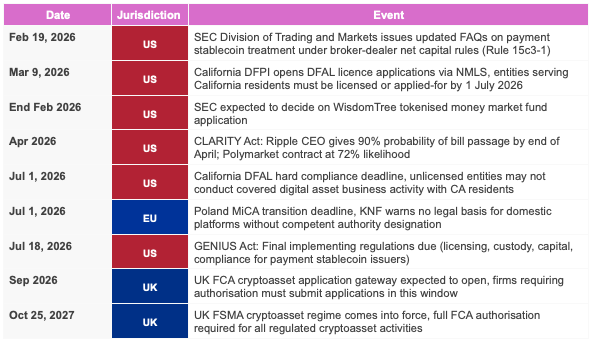
March 2026 marks a critical legislative period for US cryptocurrency regulation, with the Senate Banking Committee’s CLARITY Act markup expected following months of closed-door negotiations. The UK-US Transatlantic Taskforce is due to deliver its recommendations on regulatory coordination in March 2026, providing a blueprint for cross-jurisdictional harmonisation that could significantly reduce compliance costs for firms operating in both markets. April represents the deadline that Ripple’s Garlinghouse and Senator Moreno have identified as critical ,a 90-day window in which the combination of White House pressure, bipartisan appetite, and political momentum from the November midterm calendar creates the highest probability of legislative action on comprehensive market structure reform.
May 2026 brings the FT Digital Assets Summit on 13–14 May in London, positioned after several regulatory milestones, including the April 2026 CONV3RGENCE & Awards event at Mansion House and initial GENIUS Act implementation guidance. July 18, 2026, remains the GENIUS Act implementation deadline, requiring regulators to finalise rules covering issuer licensing, capital requirements, custody standards, and anti-money laundering provisions. September 2026 marks the opening of the FCA’s cryptoasset authorisation gateway, giving firms applying under the new UK regime their first opportunity to submit applications, with the 25 October 2027 regime commencement creating a clear two-year compliance runway from today’s date.
Market Structure and Security Outlook
Bitcoin’s technical picture remains bearish, with the cryptocurrency requiring a decisive reclamation of $80,000–$84,000 to restore constructive market structure and rebuild confidence that the January breakdown represents an extreme rather than a structural regime change. The next major macro catalyst is US PCE inflation data on 28 February 2026, which could accelerate or delay Federal Reserve rate expectations and thereby drive the next significant directional move in digital assets. The Supreme Court tariff ruling on Friday, 20 February, could trigger additional volatility given crypto’s elevated correlation with risk assets.
Cybersecurity investment must accelerate to meet the threats revealed by January 2026’s $370 million loss record. The emergence of physical phishing as a new attack vector, complementing digital phishing, address poisoning, deepfake scams, and social engineering, means that comprehensive security postures must now extend beyond digital defences to encompass physical mail verification protocols, hardware wallet authentication workflows, and employee security awareness training covering both online and offline attack scenarios. Firms operating across multiple jurisdictions face a complex matrix of requirements spanning the US GENIUS Act, EU MiCA, UK FSMA Cryptoassets Regulations, and various Asian frameworks, requiring a unified compliance infrastructure rather than jurisdiction-by-jurisdiction patchwork approaches.
UPCOMING EVENTS & INDUSTRY ENGAGEMENT
📊 CONV3RGENCE & AWARDS 2026 📊
DCW's flagship CONV3RGENCE event continues to serve as a premier gathering for the digital asset, blockchain, DePIN, AI, ScienceTech, and Web3 sectors, drawing DCW Community members and the broader industry. The event brings together industry leaders, policymakers, institutional investors, and innovators to explore the intersection of emerging technologies with traditional financial infrastructure.

IMPORTANT ANNOUNCEMENT
CONV3RGENCE & The Digital Commonwealth Awards 2026 Mansion House, Londo
New Date: Wednesday, 22nd April 2026
Previous Date: Thursday, 23rd April 2026
Due to venue scheduling requirements at Mansion House, we have moved the event forward by one day. Sincere apologies for any inconvenience this may cause, and we appreciate your understanding and flexibility.
Excited to welcome you to Mansion House in three month
Participants can register for updates and attendance information at https://luma.com/8weeiwua.
Award registration is here: https://luma.com/8weeiwua
You have to be in it to win it link:
The CONV£RGANCE theme takes on heightened significance in 2026 as regulatory frameworks crystallise across major jurisdictions, institutional adoption accelerates despite short-term volatility, and technology integrations between AI and blockchain (such as Ethereum's ERC-8004 standard) demonstrate practical applications beyond speculative use cases. The awards component recognises organisations and individuals demonstrating leadership in compliance, innovation, institutional adoption, regulatory engagement, and sustainable business model development within the rapidly maturing digital asset ecosystem. Recognition of compliance leadership and regulatory engagement reflects the industry's maturation from opposing regulation toward collaborating with authorities to develop workable frameworks that balance innovation with appropriate safeguards.
Smarter Faster Payments 2026 - April 26-29, 2026, San Diego
Nacha's Smarter Faster Payments 2026 features a new dedicated stablecoin track, reflecting the payment industry's recognition that stablecoins represent a fundamental shift in payment infrastructure comparable to the instant payments transformation that occurred over the past seven years. The conference features 130 sessions across 11 tracks, with panels examining how stablecoins bridge the gap between digital payments and traditional assets, regulatory frameworks under the GENIUS Act that will govern stablecoin issuance and operation by July 2026, and opportunities for financial institutions of all sizes to serve as stablecoin custodians or issue stablecoins under their own brands.
Industry leaders characterise the stablecoin movement as similar to where instant payments were six or seven years ago, with opportunities for community banks, credit unions, and regional financial institutions to participate in the ecosystem without requiring massive technology investments or competing directly with large money-center banks. The GENIUS Act's two-tier licensing structure, federal licensing for issuers exceeding $10 billion, state licensing options for smaller issuers, creates pathways for institutions of various sizes to enter the market with appropriate regulatory oversight and capital requirements. The April timing allows participants to incorporate early implementation guidance from Treasury and banking regulators as they finalise rules ahead of the July 18th deadline.
FT Digital Assets Summit - May 13-14, 2026, London
The Financial Times Digital Assets Summit returns in May 2026 as the leading forum for institutional leaders, innovators, and investors exploring the convergence of crypto, blockchain, and mainstream finance. The summit's timing in mid-May positions it strategically after several critical regulatory milestones: Jerome Powell's May 15th term expiration and potential Kevin Warsh confirmation as Federal Reserve Chair; publication of UK FCA's final rules following the February 12th consultation deadline; and initial implementation guidance for the GENIUS Act ahead of the July 18th finalisation deadline. These developments will enable substantive discussion of regulatory implementation challenges, compliance approaches, and business model adaptations as firms navigate the transition from regulatory ambiguity to structured governance.
The summit will likely focus heavily on institutional adoption trajectories following Q1 2026's market volatility, with particular attention to lessons from the January 30th selloff that saw Bitcoin break critical technical support whilst the Senate Agriculture Committee simultaneously passed landmark legislation. The disconnect between positive regulatory developments and severe negative price action demonstrates that macro policy uncertainty currently dominates sector-specific catalysts, creating opportunities for sophisticated institutional participants who can navigate volatility whilst building long-term positions during periods when retail sentiment reaches extreme fear levels. Panels will examine institutional positioning strategies, portfolio allocation methodologies, and risk management frameworks appropriate for digital assets' demonstrated correlation with broader risk appetite rather than as truly uncorrelated alternative assets.
CONCLUSION
The final week of January 2026 witnessed cryptocurrency markets experience their most severe stress test since early December, with Bitcoin's breakdown below the 100-week moving average to $82,000 and the Crypto Fear & Greed Index collapsing to 16 (Extreme Fear), representing fundamental challenges to near-term bullish narratives. The violent selloff, triggered by speculation surrounding Kevin Warsh's expected nomination as Federal Reserve Chair, demonstrated digital assets' positioning as highly levered expressions of monetary policy expectations rather than uncorrelated alternative assets, with 8% single-day Bitcoin decline amplifying traditional markets' modest weakness by 10-15x despite both sectors facing identical macroeconomic catalysts.
The week's dramatic reversal occurred despite significant positive regulatory developments, with the Senate Agriculture Committee's successful passage of the Digital Commodity Intermediaries Act on January 30th representing the first major crypto market structure legislation to clear committee and explicitly placing digital commodities, including meme coins, under CFTC jurisdiction. The landmark legislation's overshadowing by macro concerns demonstrates that regulatory progress, whilst necessary for long-term institutional adoption, currently takes secondary importance to Federal Reserve policy trajectory, dollar strength dynamics, and broader risk appetite as primary drivers of cryptocurrency price action. The disconnect reinforces that 2026 represents a transitional year where regulatory foundations are being laid whilst markets navigate monetary policy uncertainty and technical corrections from 2024-2025's substantial rallies.
Cybersecurity developments dominated beyond market volatility, with Chainalysis research revealing Chinese-language money laundering networks now process 20% of all illicit crypto funds, moving $16.1 billion in 2025 through sophisticated operations that demonstrate industrial-scale criminal infrastructure. The networks' extreme processing speeds (1.6 minutes for large transactions through automated Black U services), six distinct service typologies, and geographical expansion into Africa create unprecedented challenges requiring enhanced cross-border law enforcement coordination, real-time fraud detection systems, and capacity building in low-capacity jurisdictions. The convergence with 2025's overall crypto crime exceeding $4.04 billion (up 34.2% year-over-year) and AI-powered deepfake scams exploding 700% underscores the urgent need for comprehensive security investments that crypto-native firms must budget at 15-25% of operating costs.
Ethereum's mainnet deployment of the ERC-8004 standard on January 29th represents a significant technical milestone, positioning the network as a potential settlement layer for AI-to-AI interactions, introducing identity, reputation, and validation registries enabling AI agents to be verified and maintain trust across decentralised applications. The development demonstrates blockchain technology's expanding value proposition beyond decentralised finance toward positioning as critical infrastructure for the emerging AI agent economy, though the timing coinciding with market turmoil limited immediate price appreciation. The broader convergence of AI and blockchain technologies through practical implementations like ERC-8004, combined with major banks reducing OpenAI reliance and diversifying large language model deployments, signals the maturation of both sectors toward complementary rather than competing infrastructures.
For market participants, the week ending January 30th, 2026, marks a critical inflexion point requiring recalibration of expectations and strategies. Bitcoin's technical breakdown below $87,145 support, which has held nine times since November 2025, fundamentally alters near-term risk/reward profiles, with sustained trading below $84,000 potentially targeting $75,000-$80,000 support from April 2025's correction. The extreme fear sentiment reading (16, representing the 8th percentile historically) creates conditions where weekend and early-week price action determines whether markets establish a capitulation bottom or face further deterioration. Precious metals' parallel 5-6% corrections from record highs, alongside crypto's selloff, demonstrate that even traditional safe-haven assets are vulnerable to profit-taking after parabolic rallies, challenging digital gold narratives and suggesting that institutional allocators currently view precious metals as superior portfolio diversifiers.
The overarching theme for late January 2026 is the collision between long-term positive fundamentals (regulatory clarity advancing, institutional infrastructure maturing, technology innovations deploying) and near-term negative catalysts (Fed Chair uncertainty, technical breakdowns, institutional outflows, extreme fear sentiment). This dynamic creates divergent opportunities: sophisticated institutions can build long-term positions during periods when retail sentiment reaches extreme fear, whilst firms unable or unwilling to weather volatility and invest substantially in compliance face pressure to exit or consolidate. Winners will balance patience during volatility with urgency in regulatory preparation, treating the January selloff as a potential accumulation opportunity whilst recognising that decisive Fed Chair nomination, technical reclamation of $87,000, and stabilisation of institutional flows remain prerequisites for sustained recovery.
The path forward requires acknowledging that cryptocurrency markets' correlation with traditional risk assets (currently above 0.70 with Nasdaq futures) and demonstrated 10-15x amplification of macro moves position digital assets as speculative, rate-sensitive exposures rather than defensive alternatives during genuine uncertainty. This positioning does not invalidate long-term bull cases premised on technological innovation, regulatory clarity, and institutional adoption, but it does demand realistic assessment of how monetary policy trajectories, dollar dynamics, and broader risk appetite drive short-to-medium-term price action regardless of sector-specific positive developments. Those who adapt strategies accordingly, invest in compliance infrastructure, and help shape emerging regulatory frameworks will thrive. Those who resist reality or fail to build defensive capabilities face obsolescence as the industry matures from regulatory adolescence into structured governance that will reshape global finance for decades to come.
DCW DAILY BRIEF, STAY INFORMED
Posted on our Website, The DCW Daily Brief for weekday updates on regulatory developments, market intelligence, and cybersecurity alerts across digital assets, blockchain, DePIN, and Web3:
Links to this week’s Daily Brief In partnership with BCB Group, KULA, TPX, Vault12, Wincent and World Mobile
Monday, 16th February 2026
https://www.thedigitalcommonwealth.com/posts/thedcwdailybrief-160226
Tuesday, 17th February 2026
https://www.thedigitalcommonwealth.com/posts/thedcwdailybrief-170226
Wednesday, 18th February 2026
https://www.thedigitalcommonwealth.com/posts/thedcwdailybrief-180226
Thursday, 19th February 2026
https://www.thedigitalcommonwealth.com/posts/thedcwdailybrief-190226
Friday, 20th February 2026
https://www.thedigitalcommonwealth.com/posts/thedcwdailybrief-200226
DCW Institute and Other DCW Publications:
DCW Institute: Welcome to the inaugural edition of DCW Global Regulatory Changes - a monthly intelligence briefing covering material regulatory developments across digital assets, cryptocurrency, stablecoins, real-world asset tokenisation, artificial intelligence, quantum computing, virtual asset service providers, and global financial markets.
Thank you to @Nate Bradley & Datavault AI, Inc. Inc for being our initial sponsor.
DCW Research Quantum computing
This week's edition of Frontier Focus, in partnership with Quantum Fort
https://www.thedigitalcommonwealth.com/posts/dcw-frontier-focus-edition-12
Laffing all the way to bankruptcy. February 18, 2026 with Temple Melville
https://www.thedigitalcommonwealth.com/posts/laffing-all-the-way-to-bankruptcy
📋 Important 🛡️ Notices ⚠️
Educational Content Only
This newsletter offers educational insights into developments in digital assets, regulation, and financial markets. It is not intended as investment advice, financial advice, or a recommendation to buy, sell, or hold any cryptoassets or financial instruments.
Cryptoasset Risk Warnings
Cryptoassets are largely unregulated in the UK. You may not be protected by the Financial Services Compensation Scheme or the Financial Ombudsman Service if something goes wrong. The value of cryptoassets can go down as well as up, and you could lose all the money you invest. Tax treatment depends on individual circumstances and may change.
No Professional Relationship
By reading this newsletter, you acknowledge that no professional, advisory, or fiduciary relationship is created between you and the authors or publishers. This information should not be relied upon as a substitute for consultation with qualified professionals in legal, financial, security, or other relevant fields.
Accuracy and Currency
While we endeavour to ensure accuracy, the information provided may not be current, complete, or applicable to your specific circumstances. Regulatory requirements and market conditions evolve rapidly. You should conduct your own research and seek professional advice before taking any action based on this information.
Date of Publication: February 20th, 2026
Edited by EAJW © 2026 DCW Weekly Digest. All rights reserved.


